By Stuart Richards
BBC News, Brighton |

 Wooden moulds are piled on top of each other before the carving starts |
While visions of Egypt continue to attract tourists to this summer's Sand Sculpture Festival in Brighton, there is already talk of the event renewing its acquaintance with the south coast city in 2006.
Nearly 10,000 tons of specially-imported sand was used to create more than 150 sculptures of pyramids, mummies and Egyptian gods at Brighton Marina.
Dutch organiser Huib Joor, 32, is so pleased with the festival's first visit to England that he would be more than happy to bring it back next year - as long as something can be done to stop people throwing pebbles from the beach at his displays.
"From the beginning, as soon as the first sculptor was on site, we had people throwing rocks at the sand," said Mr Joor.
'Annoying problem'
One crocodile sculpted into a River Nile scene had its jaw and mouth irreversibly damaged.
Sussex Police said they had received two reports of stone throwing, on 16 and 27 July.
"We want to catch them," warned Mr Joor.
 | Cleopatra is one of many Egyptian sculptures on display 
|
"It's an annoying problem, but it happens everywhere and you have to live with it."
Thousands of pounds has been spent on extra security and protective netting around the perimeter of the site.
For two weeks from 20 June, the fine, cube-shaped sand was shipped in from the River Maas in southern Holland.
Adding water to the sand compacts the grains together and that is how the sculptures keep their shape.
"The sand gets here in piles," Mr Joor explained.
"You use wooden moulds for the sand and water, which is then compacted with what we call a 'whacker'.
"The artists then start carving from the top down because it is impossible to do it the other way."
The sculptures started taking shape on the seafront from 4 July and the festival opened to visitors 10 days later.
Mr Joor said city councillors had a strange smile on their faces when the idea of a sand sculpture festival beside Brighton's pebble beach was first put to them.
"But we explained what we had done before and the council were accepting and enthusiastic.
"People were glad that something new was finally happening."
Mr Joor said the two Dutch companies behind the project - Proserv, an events and catering firm specialising in sand and ice sculpting, and Inaxi, which provides the artists - chose Brighton as the venue as they "prefer to be near a beach, in a place that has culture".
The Sand Sculpture Festival started out about 15 years ago as a carving contest on a beach in Scheveningen, near The Hague, in the Netherlands.
Since then it has been taken all around Europe, as well as to China and Israel.
Egg white
�1m was invested in the Brighton project so Mr Joor is pleased when visitors say they have enjoyed the show.
"It's good to hear their reactions and I always thank them.
"But you always get sceptics who think we use cement or glue, whatever they think sticks it together."
 The sphinx sits protectively in front of the pyramids |
Sally Hall, who visited the site on Tuesday, was one such sceptic. She told the BBC News website: "I'm not convinced it's all sand. I think there's something binding it together.
"The finish is too smooth as well, there must be a thin coating of something brushed over it."
Mr Joor admitted they had a finishing process called "screening", where a thin layer of egg white is applied to the sculptures to stop wind blowing the surface sand into people's faces.
Apart from that though, the likes of Cleopatra and the sun god Ra are 100% sand and water, he insisted.
A spokeswoman for Brighton and Hove City Council said the owners of the marina site were planning some big redevelopments, but the festival could be staged there again.
"All things being equal, if the site was available, they would have to apply for planning permission again," she said.


 One-Minute World News
  News services

 E-mail this to a friend
  Printable version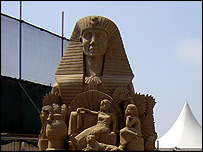
 In pictures
 I'm not convinced it's all sand


