Greig Watson
BBC News Online, East Midlands |

Sqn Ldr Clive Rowley describes the Memorial Flight 
|
The one image which to many people represents wartime Britain and a spirit of defiance in the face of a powerful enemy is that of the Spitfire. It has come to epitomise a pivotal moment in history, a sense of bravery, ingenuity, skill and determination.
The Battle of Britain Memorial Flight is a group of Royal Air Force volunteers, based at Coningsby in Lincolnshire, who dedicate themselves to keeping alive the memory of the planes, their crews and the deeds for which they became so famous.
This year marks the 60th anniversary of D-Day and the flight's new commanding officer is eager to face the challenges and privileges his position brings.
Squadron Leader Clive Rowley was a Tornado pilot who joined the flight in 1996 but only took over the CO's position this year.
He said: "When I approach the Spitfire which actually flew in the Battle of Britain, I feel a sense of privilege.
 | No Substitute  You have no idea what it's going to be like (to fly), there is no simulator, you just go and do it You have no idea what it's going to be like (to fly), there is no simulator, you just go and do it  Squadron Leader Clive Rowley |
"It is the oldest airworthy Spitfire in the world, it is the only survivor of the Battle of Britain to be flying. "It has war wounds on the left wing, bullet holes that were repaired in October 1940. It is just an amazingly precious aircraft."
Squadron Leader Rowley is conscious of his privileged position.
"I think it would probably be true to say that just about every pilot there is, from private pilots to the most experienced airline pilots, would all give their right arm to fly a Spitfire."
He added: "The first time was terrifying. You have never flown in one before and you have never had the benefit of dual instruction.
"You have no idea what its going to be like, there is no simulator, you just go and do it."
The flight has 11 aircraft, nine of these - the Lancaster bomber, Dakota, five Spitfires and two Hurricanes - are used for displays.
He said: "I don't think people entirely understand the scale of what we do and the effort it takes.
Difficult questions
"This year we have planned over 700 individual appearances, 60 air shows and over 300 other events which range from school fairs to ceremonial fly pasts for the Queen. We got over 1,000 bids for participation this year."
Perhaps the highlight of this season is the anniversary of D-Day, including the Lancaster dropping one million poppies off the Normandy coast.
"Some people might argue that the aircraft are too precious to fly," said Squadron Leader Rowley "but I disagree.
"They should not be parked on the ground in a dusty museum, they should be viewed in the sky.
"You should be able to hear the sound of them, see them flying and taking off and landing. Warrant Officer Dick Harmer, the flight's Engineering Officer, said: "The aircraft are worked on all winter and the hours they can be flown are strictly limited.
"And seeing them fly is what it is all about. I have never lost the thrill of working with these machines.
"The sound of one of them flying still makes the hair on my neck stand up."
Military historian Professor Richard Holmes said: "The Battle of Britain Memorial Flight is a remarkable institution.
"It commemorates the valour of aircrew and the sheer hard work of the ground crew who kept their machines in the air.
"And the skill of designers and engineers who created these war-winning aircraft at a time when the technological edge was sometimes only wafer-thin."
Ron Lovatt, 76, from Woodhall Spa trained in Dakotas in 1948 with the 33rd Airborne light regiment.
He said: "It's good to see the aircraft preserved, it's good for people like myself to see and I think it's good for those who did not experience those years at all."


 One-Minute World News
  News services

 E-mail this to a friend
  Printable version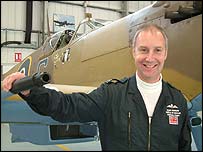
 In pictures


