
|
 |
 | | | | | | |||||||||||||||||||||||||||||||||||||||||||||||||||||||||||||||||||||||||||||||||||||
| | | You are in: UK: England | |||||||||||||||||||||||||||||||||||||||||||||||||||||||||||||||||||||||||||||||||||||||
|
| | Wednesday, 11 December, 2002, 10:19 GMT Rail still dangerous say survivors 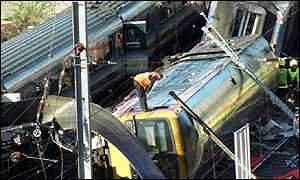 The Paddington rail crash killed 31 people Three years after the Paddington rail disaster the industry is being accused of not doing enough to make the network safer. The Paddington Survivors Group (PSG) says there has been no real improvement in the number of derailments or signals passed at danger. The comments come on the first anniversary of government ministers and rail executives signing the rail summit declaration, which committed them to introducing new safety measures. Thirty-one people died and 500 were injured when a Thames train went through a red light and crashed almost head-on with a London-bound Great Western express at Ladbroke Grove, just outside Paddington, west London.
PSG founder Pam Warren, who was badly burnt in the crash, said: "How can the public leave their cars and trust the trains?" The group said there was confusion over the structure of the rail industry and question marks over sub-contracting and maintenance. It cites the Potters Bar accident in May, in which seven people died, as one example of the problems the industry still faced. 'Still dangerous' "Britain's railways remain as dangerous as ever," the PSG said. "With time elapsing, the rail industry is trying to find ways not to implement Lord Cullen's recommendations." But John Cartlidge from the London Transport Users' Committee said the Paddington survivors' criticisms were not justified. "Clearly the group, understandably, would have liked the industry to have made even more progress, and faster, than it has," he told BBC London. "Our view is that, given the scale of the task, commendable progress has been made." | |   See also: 12 Nov 02 | England 23 Jul 02 | UK 13 Mar 02 | UK 04 Jul 01 | UK 19 Jun 01 | UK 01 Oct 00 | UK Internet links: The BBC is not responsible for the content of external internet sites Top England stories now: Links to more England stories are at the foot of the page. | |||||||||||||||||||||||||||||||||||||||||||||||||||||||||||||||||||||||||||||||||||||
| |
|  E-mail this story to a friend E-mail this story to a friend |
| |
| Links to more England stories |
| | | ||
 | ||||
 | | Back to top
| ||
| ---------------------------------------------------------------------------------- To BBC Sport>> | To BBC Weather>> | To BBC World Service>> ---------------------------------------------------------------------------------- © MMIII | News Sources | Privacy |




 How can the public leave their cars and trust the trains?