|
 |
 | | | | | | ||||||||||||||||||||||||||||||||||||||||||||||||||||||||||||||||||||||||||||||||||||||
| | | You are in: UK: Education | ||||||||||||||||||||||||||||||||||||||||||||||||||||||||||||||||||||||||||||||||||||||||
|
| | Wednesday, 27 November, 2002, 14:17 GMT Doubts over greater school diversity 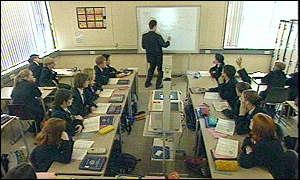 There are now nearly 1,000 specialist schools England's school inspectors have said there is no evidence that standards are improved by greater "diversity" in secondary schools - the main plank of government reforms.
Giving evidence to MPs, Ofsted officials said it was too early to judge the effectiveness of specialist schools, but their exam results were improving at a rate "broadly similar to the national picture". On Tuesday, the prime minister, Tony Blair, said his specialist replacements for "one size fits all" comprehensives were the route to "social justice" for deprived children. There are now almost 1,000 specialist schools in England and the government has promised 2,000 of them by 2006 - with ultimately no limit. Application process Mr Blair was speaking at the annual conference of the Technology Colleges Trust, which manages the specialist schools programme for the Department for Education. There are now eight specialisms: technology, sports, arts, languages, engineering, science, maths and computing, business and enterprise. To gain specialist status, schools have to raise �50,000 in sponsorship and produce a plan to show how they will raise standards and, in theory, benefit other schools in their area. If their bids are successful, they get a grant of at least �100,000 and up to �123 per pupil for four years. In evidence to the cross-party Commons education select committee, Ofsted said a fifth of schools sought to become specialists purely to get the extra cash. Results trend The Technology Colleges Trust said it estimated that 54% of pupils in specialist schools got at least five GCSEs at grades A* to C, or their vocational equivalents, compared with 46% in ordinary comprehensives. But Ofsted said specialist schools' exam results did not provide clear proof that they were better than ordinary comprehensives. The inspectorate's secondary division manager, Mike Raleigh, said specialists were getting better, but not dramatically. "Their trend of improvement is about the same as the national one." 'Encouraging' Ofsted's director of inspection, David Taylor, said: "I don't think we would have the evidence to say going for diversity in itself necessarily drives up standards more than a single system." Later he added that it was too soon to judge the effectiveness of specialist schools. "We would like to come back to you in three or five years and say now we have a much more established diverse system and we are able to judge." He added: "At the moment there are some encouraging features in the inspection indicators to sit alongside the slightly more ambivalent ones about exam results." 'Damaging debate' Mr Blair argued that the comprehensive ideal had failed because it treated every child the same. "Elitism versus equality is the way the debate was put and it's done enormous damage to conduct it in this way," he said. "Our reforms are not about encouraging elitism, but about giving more children a fair chance. "Reform is not the enemy of social justice and educational advance but the route to it. "Specialist schools are not a means of shutting deprived children out of excellence, but a means of giving them access to it." The Secondary Heads Association - which is due to see the committee on Thursday - is likely to repeat its view that the government should be striving to promote diversity within each school, rather than creating greater diversity between schools. | | See also:  19 Jul 02 | Mike Baker 16 Jul 02 | Education 16 Jul 02 | Education Internet links: The BBC is not responsible for the content of external internet sites Top Education stories now: Links to more Education stories are at the foot of the page. | ||||||||||||||||||||||||||||||||||||||||||||||||||||||||||||||||||||||||||||||||||||||
| |
|  E-mail this story to a friend E-mail this story to a friend |
| |
| Links to more Education stories |
| | | ||
 | ||||
 | | Back to top
| ||
| ---------------------------------------------------------------------------------- To BBC Sport>> | To BBC Weather>> | To BBC World Service>> ---------------------------------------------------------------------------------- © MMIII | News Sources | Privacy |