|
 |
 | | | | | | |||||||||||||||||||||||||||||||||||||||||||||||||||||||||||||||||||||||||||||||||||||||||||||||||||||||||||||||||||||||||||||||||||||||||||||||||||||||||
| | | You are in: UK: Education | |||||||||||||||||||||||||||||||||||||||||||||||||||||||||||||||||||||||||||||||||||||||||||||||||||||||||||||||||||||||||||||||||||||||||||||||||||||||||||
|
| | Thursday, 22 August, 2002, 02:16 GMT 03:16 UK GCSE 'gender gap' sparks concern 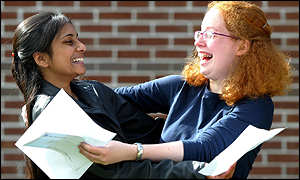 Esha Aggarwal and Naomi Sather have 22 GCSEs This year's GCSE exam results, which more than 600,000 students are getting on Thursday, show that girls are still outstripping boys in almost every subject. The government says it is worried by the "unacceptable" gender gap of nine percentage points at the top grades.
The overall pass rate in the more than five million papers sat this year in England, Wales and Northern Ireland was identical to last year's: 97.9%. Those getting the top grades has risen for the 14th year in a row, by 0.8 to 57.9%. The proportion of grades A* and A awarded went up less than a third of one point, to 16.4%.
As usual Wales did better than England, with 59.7% getting A* to C grades as opposed to 57.4% - and Northern Ireland recorded 68.4%. 'An issue' The convenor of the Joint Council for General Qualifications, which issued the results, John Milner, said this indicated that GCSEs were "a stable qualification". "Not a tremendous amount is happening to it," he added - a comment on the big changes in A-levels which resulted in a jump in the pass rate last week. But he said the gender gap was "clearly an issue". The difference at grades A* to C, which had narrowed a little last year to 8.9 percentage points, has risen again to nine points, with 62.4% of girls' exam entries achieving the top grades and 53.4% of boys'. 'Gender neutral' Even in the "boys' toys" subject - information technology - the girls are doing better. The gap has gone up from 6.4 points to 8.7.
"We make sure questions are fair and balanced and we will certainly be happy to participate in any work that's looking at the reasons for the gender gap - we would be delighted to get involved." David Hart, general secretary of the National Association of Head Teachers, said that while the results demonstrated a good performance by many students, "the boys are dragging down the results". "There is not a cat in hell's chance of significantly reducing the 40% of results that are below grade C, unless the boys raise their game," he said. The Minister for Lifelong Learning and Higher Education, Margaret Hodge, praised the hard work of teachers and students but also said there was still room for improvement. 'Must try harder' But she said the gap between boys and girls "remains worryingly high". "The achievement gap between boys and girls remains unacceptable," she said. "We already have a number of initiatives in place to reduce the gap but we will continue to identify other ways of responding to the gender difference." An idea in a government consultation on 14 to 19 education is to allow bright, "fast-track" pupils to by-pass GCSEs and go straight to AS-levels. Targets But Mrs Hodge said: "GCSEs remain a vital indication of young people's progress and our reform agenda has made it clear that we are ambitious for all young people." The government has set various goals for the GCSEs - for instance that 95% of students should get at least one pass by this year, and that all schools should have at least a fifth of their students getting five top grades by 2004. This year's collated raw results relate to exam entries, not the performance of students or schools, so do not show what progress has been made towards these targets. The school-by-school results on which the league tables in England are based are published towards the end of the year. Mrs Hodge said the latest figures did suggest that "we are moving in the right direction but we still have much work to do". 'Change needed' The Conservative spokesman, Damian Green, said they showed that too many boys were "turned off learning". "We need urgently to improve the courses we offer in secondary schools, particularly to those who have practical skills." This year's vocational results show there were 66,000 Intermediate GNVQ entries, with a pass rate of 71.5% - girls beating boys by 7.8 percentage points. The first of the new Vocational GCSE courses start this autumn.
"Other countries provide much better vocational courses, which keep more pupils engaged in school and therefore willing to take GCSE-type academic exams as well," Mr Green said. The Liberal Democrats' Phil Willis - paraphrasing the education secretary's attack on comprehensive education - said the "one-size-fits-all GCSE system" had reached the end of its useful life. "Students, tested to destruction, are having their achievements devalued by a system that puts exams before education," he said. "A new 14-19 curriculum would allow us to replace GCSEs with an examination system more appropriate to young people's learning than government targets." | |
See also:  18 Aug 02 | Education 21 Aug 02 | Education Internet links: The BBC is not responsible for the content of external internet sites Top Education stories now: Links to more Education stories are at the foot of the page. | |||||||||||||||||||||||||||||||||||||||||||||||||||||||||||||||||||||||||||||||||||||||||||||||||||||||||||||||||||||||||||||||||||||||||||||||||||||||||
| |
|  E-mail this story to a friend E-mail this story to a friend |
| |
| Links to more Education stories |
| | | ||
 | ||||
 | | Back to top
| ||
| ---------------------------------------------------------------------------------- To BBC Sport>> | To BBC Weather>> | To BBC World Service>> ---------------------------------------------------------------------------------- © MMIII | News Sources | Privacy |