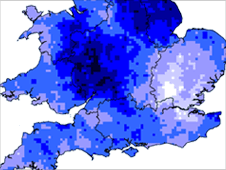
Summer 2007 was the wettest on record. The Met Office says 414.1mm of rain fell across England and Wales in May, June and July - more than at any time since it began compiling rainfall figures in 1766.
The heavy rain caused widespread flooding. In late June it brought chaos to parts of north-east and central England and a month later, to parts of central and southern England and Wales.
But although the rain was exceptionally heavy, climatologists say it was not a result of global warming. A report by the Centre for Ecology and Hydrology concluded the rain was a freak event, not part of any historical trend.
JUNE FLOODS
On 24-25 June heavy rain brought flooding to parts of Yorkshire, Derbyshire, Lincolnshire, Nottinghamshire and Worcestershire. Wet weather earlier in the month meant water levels were already high and the ground quickly became saturated when the second downpour began.
One man died after being trapped in a storm drain in Hull. Another man and a teenage boy were swept to their deaths by fast-running floodwaters in Sheffield.
According to Met Office figures, Emley Moor in West Yorkshire was the wettest place in the country in June, recording 294mm rainfall, 435% up on the average for the period 1971-2000.
Advertisement
Scenes of flooding around the UK in the summer of 2007
On 19 and 20 July, less than a month after the first severe floods exceptionally heavy rain caused flash flooding in the South East and across central and some of north-east England and parts of Wales. River flooding followed as the Severn and Thames overflowed their banks.
Two men died pumping water from a rugby club. Thousands of people had to leave their homes and many others were left without power or water.
One of the most enduring images of the July floods was the town of Tewkesbury, Gloucestershire, which was surrounded by water, but the floods threatened drinking water supplies and taps ran dry.
Pershore College in Worcestershire was the wettest place in the country in July, recording 252mm of rain, 588% above the average.
CLEAR-UP
Electricity sub-station in Tewkesbury
The Environment Agency says a total of 56,000 homes and businesses were flooded last summer.
Since then, 73,000 people have signed up for its free flood-warning scheme, but that is still less than half those eligible to receive the service.
Thirty-four new flood defences have been completed since last summer, providing protection for 30,000 homes. The agency has plans to spend another �1bn over the next three years improving protection for another 145,000 homes.
According to government figures issued in May 2008, 5,500 families have not been able to return to their homes since last summer's floods - 1,400 of them are still living in caravans.
Planning for floods remains a priority for the Environment Agency. The floods last summer highlighted the need to provide better protection for key utilities such as power stations as the likelihood of flooding increases with climate change.
In London the 2100 Thames Estuary project is looking at projected sea-level rises of between 1m and a "worst case scenario" of 4.2m over the next 100 years.
Looking ahead to the rest of this summer, the Met Office is warning that rainfall is likely to be near or above average.
 One-Minute World News


 E-mail this to a friend
  Printable version



 Enlarge Image


 BBC News


Bookmark with:
What are these?