England and Wales is on course for its wettest summer on record, but some of the UK's reservoirs and underground reserves are still not full.
A wetter-than-average May and a record-breaking soggy June and July have caused some of the most serious flooding Britain has ever known. But while most reservoirs have above-normal water levels, many are still nowhere near their capacity. And during deluge-hit June, groundwater levels actually went down in three-quarters of the measuring sites in England and Wales. Although the continuation of the summer downpours has effectively ruled out the risk of drought this year, experts say there is no cause for complacency after the droughts of recent years. RAINFALL  | WETTEST UK SUMMERS 358.4mm - 1956 342.7mm - 1985 336.3mm - 1927 327.0mm - 1931 326.0mm - 1946 |
June was the wettest on record in the UK, and July the fourth-wettest. Rainfall in much of Yorkshire was more than three times its normal total in June. Some parts of the county registered more than four times the norm. At 134.5mm, the UK monthly total beat the previous June record, set in 1980, by more than 13mm. While the UK's July total was 5mm short of the 1988 peak, the month set new highs for both England and England and Wales combined. Both nations received well over twice their long-term average rainfall for the month. And with May's totals also well above average in most parts of the UK, the early part of the summer has become a statistician's delight - and many householders' nightmare. An average August rainfall would make it officially the UK's wettest summer since records began in 1914, while England and Wales need little more than half the August norm to achieve the same status. RESERVES | See river flows in more detail 
|
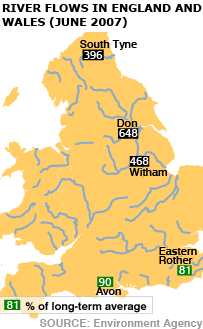
Most summer rainfall is cancelled out by extra consumption - particularly by plants, flowers and trees - evaporation and by natural loss out to sea, so little of it actually gets stored for future use. Adrian Westwood, of the Environment Agency, says an almost non-existent winter means stores are still depleted despite the extraordinary volumes of rain this summer. "Normally groundwater gets recharged during the winter, but it won't have recharged much this past year because the vegetation was still green and healthy and would still have been absorbing the water," he said. In any case, there is a limit to how much of the water plummeting from the sky can be tapped and used. "If reservoirs are full, groundwater aquifers will still absorb water, but most rain that falls goes into rivers, which go out to sea." The impact of heavy rainfall on water supplies is very localised, and as most people would expect, rivers, reservoirs and groundwater supplies in the North East of England are well above seasonal averages. Rivers and reservoirs have also been higher than normal in East Anglia and the Midlands. But in many other parts of the country, they are closer to the average. However, soil moisture deficits - the shortfall in moisture retained in the top few centimetres of soil - are almost uniformly below average. In other words, the soil is wetter than usual. Only the Thames region showed an increase in the deficit - its soil actually became drier - from May this year to June.
|  One-Minute World News


 E-mail this to a friend
  Printable version

 Enlarge Map


 BBC News


Bookmark with:
What are these?