 Gordon Brown: Reviewing child poverty policies |
The UK may soon move out of the bottom of the European poverty league because of "real progress" by government since 1997, say experts. The latest figures suggest poverty has dropped below levels of the early 1990s, but progress has been slower on education and regional inequality.
The report, published by the Joseph Rowntree Foundation (JRF), found poverty has largely dropped because more people are in work.
But it also said Labour's social and economic reforms since 1997 have also played a part in reaching this "milestone".
Million fewer in poverty
The report, as with the official poverty line, defines poverty and low income as 60% of median income - currently �114 for a single person, and �273 for a couple with two children.
Find out more about poverty 
|
> In its latest annual report for the JRF, the New Policy Institute found poverty, if measured by income alone, has now fallen to levels last seen at the end of the 1980s. In 2001-02 the number living below the official poverty line was 12.5m people, about a million fewer than during the mid-1990s.
While the UK still has proportionately more poor people than any other EU country except Greece or Portugal, the indicators suggest it is moving up the league table.
The authors found poverty has lessened in 21 of 50 broad categories. In seven cases, including family homelessness, things had got worse.
The indicators also showed while many people had moved out of poverty thanks to the improved economy - others were still struggling because they were in low-paid or insecure jobs.
In other areas, the indicators showed the poorest continuing to be the most likely to suffer ill health.
Lone mothers were the most likely to have low birth weight babies - though the number of unmarried teenagers having children had fallen.
Regional variations
The report found indicators for the east, south east and south west of England were on average better than elsewhere.
 | Worsening indicators Low-birth weight babies Homelessness Obesity Jailed young offenders Teen drug abuse Benefit take-up Reduced social services |
North east England was the only area where a majority of indicators had got worse - but the area with the highest proportion of population living in poverty was Greater London. Scotland had the worst record for poverty-related health problems while Wales had higher youth unemployment and more disability among older groups.
In education, the report found progress in increasing the numbers leaving school with minimum adequate qualification levels had stalled.
Anyone leaving school with no qualifications were three times more likely to be in low-paid work by their mid-20s than even those who just manage five basic GCSE passes.
Annual report
The annual report, considered one of the most authoritative studies of poverty and social exclusion, was launched the year after Labour came to power.
| Major reforms since 1997 1999: National Minimum Wage 1999: Working Families Tax Credit 1999: Pensioner's Minimum Income Guarantee 2002: Second State Pension 2003: Working Tax Credit 2003: Pension Credit |
Last year, it warned ministers appeared to have done little to improve conditions and were in danger of missing child poverty targets. But this latest report will encourage ministers, including Chancellor of the Exchequer Gordon Brown who launched a rethink of child poverty policies last year.
Guy Palmer, co-author of the report, said: "With five years' data available to measure progress since Labour came to office, it is much clearer where the Government's strategy for combating poverty and social exclusion is being successful - and where it is not.
"There is still a long way to go before the number of people living in low-income households reaches the levels of 20 years ago.
"But the reduction in poverty levels to below those of the 1990s is a notable milestone and suggests real progress."


 One-Minute World News
  News services

 E-mail this to a friend
  Printable version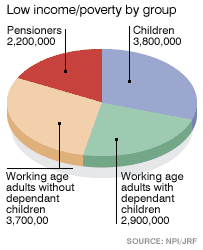
 At-a-glance