|
 |
 | | | | | | |||||||||||||||||||||||||||||||||||||||||||||||||||||||||||||||||||||||||||||||||||||||||||||||||||||||||||||||||||||||||
| | | You are in: UK | |||||||||||||||||||||||||||||||||||||||||||||||||||||||||||||||||||||||||||||||||||||||||||||||||||||||||||||||||||||||||||
|
| | Wednesday, 7 August, 2002, 17:57 GMT 18:57 UK Livestock missing from country shows 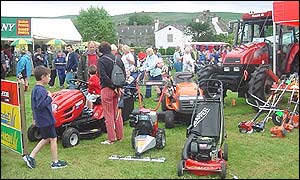 Thousands of people visited the show
At a country show in Cumbria it was clear that farmers are still being affected by foot-and-mouth movement restrictions. Attend most country agricultural shows this year and you may find something missing. Gardeners will still be vying for the largest marrow prize, members of the Women's' Institute will be battling it out for the best chutney and there will be steam engines and face painting for the children. There may be horse and dog shows and a selection of the best chickens and rabbits. But cattle and sheep will be a rarity. The restrictions still in place because of the foot-and-mouth outbreak mean many farmers do not want to take their stock to shows, and then endure the consequences. A 20-day movement restriction rule currently in force means farmers returning to their farms with stock from a market or show cannot take other livestock off that premises for another 20 days. Disease free The Department for the Environment, Farming and Rural Affairs, (Defra) says this is good veterinary and biosecurity practice that will prevent a repeat of the outbreak that devastated the farming community last year.
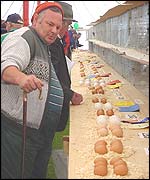
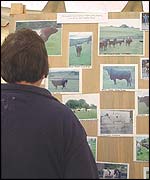
But farmers say that as the UK is now officially foot-and-mouth free, the restrictions are over the top and continue to threaten livelihoods. Some county shows across the country have and will include livestock. In order to avoid the disruption and restrictions caused by the 20-day rule, the Cartmel Agricultural Show, in the south of Cumbria, was noticeably devoid of livestock. Thousands of people still visited the show and enjoyed the displays of horse and dog trials, country crafts, vegetable competitions and other traditional events and activities. But along with horses and dogs, the only other animals on show were rabbits, poultry and pigeons. Livestock judges had to visit the farms to judge the cattle and sheep entries. Farmers agreed this was less hassle than bringing animals to show but it made for a somewhat hollow victory. Making contacts One winner Michael Dobson, 21, of Broad Oak Farm near Crossthwaite, said his father, grandfather and great-grandfather had attended the Cartmel show to exhibit their Pedigree Dairy Shorthorns (old English milk cows to the untrained eye.)
"And some cows do like to show themselves off, they're real posers." Mr Dobson said shows were also an opportunity for potential buyers to see the quality of stock and make contacts with breeders. He said Defra's suggestion of isolating show cattle was impractical given that cows are part of a herd and do not like being separated. Most farmers agreed the 20-day rule was over-restrictive made farming almost impossible. Farmer David Inman, 48, from Witherstack, said the rule was financially and socially crippling. "It is the time of year when you tend to sell a lot of stock. "But if you take something to market you more or less have to accept what you are offered because if you bring it back you can't sell anything for three weeks," he said. "The sales are at certain times of year so if you miss a date you are struggling." Wrong image Mr Inman said reducing the 20-day limit to six would be more workable. Herds judge David Woof, 53, of Under Elm Farm at Oxenholme, said he feared the industry would lose farmers as a result of the rule. "We just can't operate and sometimes it drives farmers to villains and they do things they shouldn't be doing."
Farmer Neil Sowerby, 30, of Four Winds Farm at Meathop near Grange-over-Sands, said the importance of the shows went even further. He said videos and news film of cows with BSE then burning pyres of foot-and-mouth carcasses had given a distorted perception of farming today. He said: "Shows are a chance to show the general public how animals are cared for and looked after, they are a shop window to the public." He said the restrictions appeared to be more about keeping officials in jobs than protecting animal welfare. He said the country needed special committees made up of people with practical experience of the industry to make those sorts of decisions. Talks continue "Agriculture needs an image change but the government is making it harder and harder when they put over the image that farmers just moan," said Mr Sowerby.
"They are business-orientated people but they are not in it for the money - otherwise they wouldn't be there now." The extent of the restrictions is still being negotiated between farming organisations and the government. A Defra spokesman said: "We are not saying the restrictions will be in place forever but we need to take into account the Royal Society and Anderson inquiry recommendations." He said Defra was pleased that show organisers had recognised the need for strict biosecurity controls to protect the wider community from another outbreak. | |
See also:  01 Aug 02 | UK 22 Jul 02 | Politics 16 Jul 02 | Science/Nature 16 Jul 02 | Science/Nature Internet links: The BBC is not responsible for the content of external internet sites Top UK stories now: Links to more UK stories are at the foot of the page. | |||||||||||||||||||||||||||||||||||||||||||||||||||||||||||||||||||||||||||||||||||||||||||||||||||||||||||||||||||||||||
| |
|  E-mail this story to a friend E-mail this story to a friend |
| |
| Links to more UK stories |
| | | ||
 | ||||
 | | Back to top
| ||
| ---------------------------------------------------------------------------------- To BBC Sport>> | To BBC Weather>> | To BBC World Service>> ---------------------------------------------------------------------------------- © MMIII | News Sources | Privacy |