By Charles Haviland
BBC News, western Nepal |
  | Maoist rebels in Palpa district intersperse military training with public works projects 
|
Four months into the ceasefire in Nepal, Maoist rebels and the army are preparing to be confined in camps under United Nations monitoring. The Maoists are refusing to disarm completely. Indeed, there are fresh reports of them abducting and even killing people in some places. But in other locations they are on a drive to win ordinary people's hearts and minds. They have also started building camps in their own favoured locations. One is a hilltop in the village of Muntang in the rugged hills of Palpa in western Nepal. Anti-monarchy slogans Here men and women of the Krishna Sen Memorial Brigade dig in, building sentry posts and bunkers, living in large blue-and-white tents and eating communally. Previously the rebels were more fragmented, living nomadically, going from house to house and demanding food and accommodation. "The current ceasefire requires a place for us to be together," says Comrade Seetal, the brigade's commissar or senior political figure. He denies the site is aimed at intimidating the Nepalese Army, based at the district headquarters of Tansen which is visible 30km (19 miles) away across a spectacular, gleaming river valley. In the village, Maoist leaders join in a traditional Hindu festival, banging cymbals and dancing - and persuading the revellers to shout anti-monarchy slogans. After the dancing, the guerrillas promise they now want peace. "Without you, we can't do anything," one tells the crowd. "You've given us so much love, such a welcome. If we go back to revolution, we'll all go together." As if to try and prove their good intent, the Maoists are doing community work. At a school, uniformed troops hack the soil to make a playground, watched by an eagle-eyed armed guard. Their guns are deposited in a pile at the side. 'Time for development' Nearby, Maoist doctors have opened a library and a health post, taking villagers' blood pressure and dispensing pills. We are told the houses used for these facilities are the homes of people who have migrated to the plains. The rebels were long known for destroying structures such as bridges and roads. But Commissar Seetal insists those days are over. "In the past we were preparing for war - we had no time for development," he said. "We were too much at risk from the army. But now we're closer to the people every day. Our relations are much improved." Despite this social activity, though, the guerrillas remain combat-ready and preoccupied with security. In the early morning mist, inside the camp, 50 Maoists snap their feet to shouted orders. Proudly, they display their guns above their heads in a physical training drill. The place bristles with AK-47s and other captured weapons. The rebels' team-talk has a harder edge than the briefing given to the villagers. The battalion commissar says rebel soldiers must be ready to destroy the camp and go back to war if absolutely necessary. But they must strive to work for peace, switching their orientation from a war of weapons to what he calls "a war of ideas". Gathered in the camp, some have their young children with them - some playing with the guns, even putting their fingers on the triggers.  Evidence of recent fighting is all too apparent in nearby Tansen |
The rebels have not yet agreed to be separated from their arms within the camps, despite the government's insistence that they should do so. The attitude of platoon commander Lokendra is typical. "Our arms are like a life-partner for us," he says. "It would be quite new to be separated from them. "If it's a conspiracy that makes us give them up, we'll revolt. But if it's for peace and directed by the party, I'd do anything." In Tansen, which seems a world away, people are familiar with Maoist firepower. Maoists coming from areas like Muntang attacked the town in January. 'No trust' Heavy fighting around government buildings and a radio station left more than 20 people dead. The beautiful old palace which used to house the district government is almost completely destroyed - a shell surrounded by rubble. Teacher Jhapendra Khadka came here, fleeing his village, last year after Maoists beat him up for not appointing a rebel sympathiser to a job. He points to continuing reports of Maoist violence in some villages. "I don't trust them," he says. "If they have weapons, bombs, how can we trust them?" He is worried because while the UN monitoring plan will confine the rebels and their big weapons to camps, it does not embrace the smaller weapons held by the Maoist militia (equivalent to their police) or other militias. In the village camp, the Maoists are filling their leisure time. There are regular literacy classes for their own less educated troops. In the evening light after the rain, a volleyball match. The villagers themselves are curious about their guests. Boys clamber up the hill, simply wanting to see the camp. One young woman says she is satisfied with the Maoists' new behaviour. Others will not comment, preferring to withhold judgment on how meaningful their reformed behaviour really is.
|  One-Minute World News


 E-mail this to a friend
  Printable version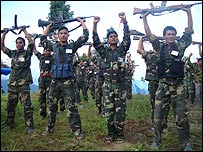
 Enlarge Image
 In the past we were preparing for war... but now we're closer to the people every day


 BBC News


Bookmark with:
What are these?