By Jonathan Fildes
Science and technology reporter, BBC News |

 | Europe's ExoMars rover is scheduled to launch in 2013 
|
The European Space Agency (Esa) has agreed to fund work on its flagship ExoMars mission despite not having final go-ahead from European ministers. The agency has said it will commit 80 million euros to fund initial work to develop the Martian robot rover.
Starting work in 2008 is crucial if Esa is to launch ExoMars, which will search for signs of life, in 2013.
European governments will not make a decision to fund the one billion euro mission until November 2008.
"If we want to preserve the launch date in 2013 we cannot stop at all," Jorge Vago, ExoMars project scientist, told BBC News.
"We need to start procuring long-lead items - the sort of stuff you order today and you get in one and a half years."
The next available launch opportunity would be 2016.
Rocket choice
The mission has already been delayed by two years after the project was redesigned to be lofted by an Ariane 5 rather than Soyuz rocket.
| EXOMARS MISSION CONCEPT Set to leave Earth in 2013; primary aim is to search for life Will launch on a heavy-lift Proton or Ariane 5 rocket Vented landing bags allow for a larger payload Rover will carry a 16.5kg 'Pasteur' instrument suite 30kg geophysics/environment static station also possible This would study the weather and listen for 'Marsquakes' Concept to cost Esa states more than first estimates |
"The cost of delaying from 2011 to 2013 was 150 million euros," said Dr Vago. "So, if we delay to 2016 you can expect something in the order of that."
The more powerful Ariane 5 was chosen as it is able to support a larger payload, allowing more scientific instruments to be carried and a possible orbiter to communicate with, and relay data, to Earth.
Esa is keen to send its own orbiting spacecraft as, under current plans, ExoMars will have to rely on the US space agency's Mars Reconnaissance Orbiter (MRO) for communications with Earth.
"The Ariane 5 mission is the right thing to do," said Dr Vago.
However, there is still a chance that the mission will have to be tweaked again if Esa decides to blast ExoMars into space on top of a cheaper Russian Proton rocket.
Launching on an Ariane 5 from Europe's own spaceport in Kourou, French Guiana, will cost about 150m euros - 60m euros more than the asking price of a Russian Proton vehicle.
Time critical
The mission's price tag will be discussed at a meeting of ministers from Esa member states in November 2008.
 The Ariane 5 rocket is the favoured launch platform |
"It could be that we go to the ministry and the countries say 'we have already given you 650 million [Euros] and now you are asking for double that, and we don't like it'," said Dr Vago.
"But we are doing what we believe is right - what is right for the mission, what is right for science, what is right for Europe and what is right for industry."
As a result, Esa has decided to stump up the first 80 million euros without a 100% guarantee that the full cost of the mission will be covered by member states.
"We are giving it all to launch in 2013 not just to contain costs but also because the time will be right for the science," said Dr Vago.
In 2010, Nasa's Mars Science Laboratory (MSL) is expected to begin sending back its first results from the surface of the Red Planet.
"We are bringing the next step in exploration technology which is subsurface science," said Dr Vago. "It will be prime time to pluck that apple - it would be a shame to delay to 2016."


 One-Minute World News
  News services


 E-mail this to a friend
  Printable version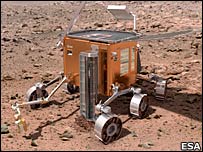
 Enlarge Image


Bookmark with:
What are these?