By Jonathan Amos
Science reporter, BBC News |

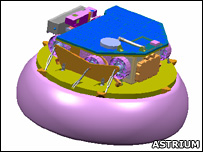
 | Vented bags should bring the rover to an immediate stop 
|
The project to design and build a European rover to send to Mars has passed an important milestone. Engineers have demonstrated a vented, or dead-beat, airbag technology that could be used to cushion the vehicle's landing on the Red Planet.
An effective entry, descent and landing system will be critical to the success of the ExoMars mission, as it is known.
The test's success will be welcome news to European space delegations as they meet on Monday to review the project.
The member states of the European Space Agency (Esa) are being asked to approve an enhanced design concept for the mission, one that would greatly improve its scientific capability but one that would also significantly increase its cost.
The prototype vented bag system investigated last week at the Centro Italiano Ricerche Aerospaziali (Cira, Italian Aerospace Research Centre) is considered an integral part of the enhanced concept.
"It is most encouraging," said Vincenzo Giorgio at Thales Alenia Space, the prime industrial partner on the ExoMars project. "We did the first test of a long series that will last for one and a half months. It went very well. The objective was to demonstrate first of all that the system did expand and deflate properly. And the second purpose was to demonstrate that it could land in the horizontal without changing its position," he told BBC News.
'Right way up'
The successful US space agency (Nasa) rovers - Spirit and Opportunity - and their landing platforms were encased in billiard-ball-like arrangements of gasbags to protect the vehicles at the moment of impact with the Martian surface.
These bags bounced more than 25 times and travelled some 200m across the dusty surface before bringing their precious cargoes to a safe and secure stop.
Europe, however, is looking to an alternative technology to land ExoMars. This would see the rover and platform come down atop a system of squashable bags. On landing, sensors would send a signal to open vents in these bags, causing a rapid but predictable deflation. It should be more accurate and bring the rover-platform to an immediate stop in an upright orientation.
It is true also to say that vented bags are untried in space ? and the ExoMars designers will have to grapple with very different performance conditions on the Red Planet.
"On Mars, there is very low atmospheric pressure," explained Steve Lingard from the UK company Vorticity, which has developed key components of the experimental set-up at Cira.
| Vented airbags have a military heritage
|
"The flow out of the airbag is at sonic velocity, so there's no feedback like you'd get with an impact on Earth. This means the whole control system has to be much more precise, much cleverer. Ultimately, we will have to test the system in a vacuum chamber to replicate conditions on Mars." The ExoMars team, though, is confident it can deliver a robust and capable landing mechanism. Mr Giorgio stated: "Seen from an industrial perspective, although this technology has never been flown before [on a space mission], the technology itself is not felt to have giant problems."
And significantly, vented bags would release the rover's designers from the very tight volume constraints that come with enveloping bouncing bags, and allow for a larger, heavier payload.
Global solutions
The ExoMars design teams are currently looking at a rover concept that is bigger than the 650m-euro "baseline" version approved by ministers in 2005.
The enhanced rover would be slightly heavier than 200kg (the American vehicles weigh about 180kg). It would have a 16.5kg instrument package, together with a drill or "mole" for burrowing beneath the Martian soil.
Its greater mass means it would need to be launched on a heavy-lift rocket like an Ariane 5 or Proton, rather than the smaller Soyuz as originally envisaged.
| ENHANCED EXOMARS CONCEPT Would leave Earth in 2013; primary aim is to search for life Could use a Proton rocket if Russians join the project Vented landing bags release some design constraints Allows for a 16.5kg instrument suite on rover vehicle A geophysics/environment static station also possible This would study the weather and listen for Marsquakes Extra cost requires Esa states to release more funds |
This is the favoured configuration being recommended again this week to Esa's Programme Board for Human Spaceflight, Microgravity and Exploration. The BBC understands that when delegations discussed it last month, there was some disquiet at the extra cost - running into tens of millions of euros.
Nonetheless, it is expected the board will authorise the teams to take the enhanced design into the next phase of detailed study.
One possible solution to meet the higher price is to ask the Russians to join the ExoMars project, and for them to provide a Proton launcher as an in-kind payment. Discussions with Roskosmos - the Russian space agency - are said to be ongoing.
This would help meet the funding gap but it also fits with the current desire for more co-operation in space, reflected in the recent Global Exploration Strategy signed by 14 national agencies.
Keith Mason is the chief executive of the Science and Technology Facilities Council, the UK's main science funding body with responsibility for space matters.
"You have to see all of this in a wider context," he told BBC News. "We want to do these kinds of missions with other countries; we want to draw in the Russians and draw in the Americans. It only makes sense to do these kinds of things as a planet, not as individual nations or regions."
[email protected]


 One-Minute World News
  News services


 E-mail this to a friend
  Printable version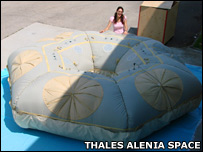
 Enlarge Image
 It only makes sense to do these kinds of things as a planet, not as individual nations or regions