By Helen Briggs
BBC News science reporter |

 | After a brief search, the recovery team found the capsule |
A capsule containing comet particles and interstellar dust has landed on Earth after a seven-year space mission. The Stardust probe released the capsule as it flew back to Earth after a 4.6-billion-km (2.8-billion-mile) trip.
The US-built capsule plunged through the atmosphere and touched down in the Utah desert at 0312 (1012 GMT).
Scientists believe the first cometary dust samples ever returned to Earth will shed light on the origins of the Solar System.
|  It is amazing to think that such minute specks of dust can carry within them so much information about the origin of stars and planets It is amazing to think that such minute specks of dust can carry within them so much information about the origin of stars and planets |
"We travelled about three billion miles in space, we visited a comet, grabbed a piece of it and it landed here on Earth this morning," Dr Don Brownlee, Stardust principal investigator, told reporters at a news briefing in Utah. "I fully expect textbooks in the future will have a lot of new information from the samples that landed here this morning."
Fiery descent
The Stardust spacecraft released the 45kg (100lb) capsule at 0557 GMT as it looped past the Earth on its return from interplanetary space.
 A day of celebration for everyone on the Stardust project |
Mission controllers at the US space agency's (Nasa) Jet Propulsion Laboratory in Pasadena, California, clapped and cheered as the capsule began its plunge to Earth. Four hours after leaving the probe, the capsule entered the Earth's atmosphere 125km (410,000ft) over the Pacific Ocean.
It reached speeds of 46,660km/h (29,000mph) - the fastest re-entry of any manmade probe - and was visible from parts of the American northwest as a streak of light in the sky.
At about 32km altitude (105,000ft), the capsule released a small parachute to slow its descent.
The main parachute opened at about 3km (10,000ft), and brought the capsule down to land on a military base southwest of Salt Lake City.
"All stations, we have touchdown," an announcer declared to a jubilant control room.
First analysis
The capsule was located by helicopter almost an hour after the landing. It was then flown to a nearby laboratory for checks.
 The capsule was prepared for onward transport to Johnson |
On Tuesday, it will be transported to a special lab at Nasa's Johnson Space Center in Houston, Texas, where scientists will get their first chance to examine the precious contents. "I'm very confident we will have samples in there that are the first returned from beyond the Moon," former Stardust project manager, Ken Atkins, told the BBC News website.
"It is magnificent to see something that we saw leave the planet on 7 February 1999 return to the planet here on 15 January 2006."
The highlight of Stardust's seven-year mission was its close encounter with Comet Wild 2 in January 2004.
 The sample-return capsule was seen to streak across the sky |
It swept up particles from the frozen body of ice and dust, flying to within 240km (149 miles) of the comet's core, or nucleus. As part of its trip, the probe also captured a sprinkling of dust that originated in distant stars.
The Stardust mothership has now completed its main mission and has been sent into orbit around the Sun.
'Minute specks'
Meanwhile the work of scientists is just beginning. On Tuesday, Nasa experts will open the canister containing the samples which is packed away inside a protective shell.
| Stardust could provide a new window into the distant past |
The capsule is believed to contain about a million particles of comet and interstellar dust left over from the birth of the Solar System 4.6 billion years ago. They are trapped inside cells filled with an ultra-light solid called aerogel.
About 150 scientists around the world will get a chance to carry out a preliminary analysis of the contents, including researchers at the UK's Open University (OU).
 Stardust took remarkable pictures of Comet Wild 2 |
Professor Monica Grady, of the OU's Planetary and Space Science Research Institute (PSSRI), said it would be the most scientifically exciting and technically challenging material with which they had ever had the opportunity to work. "Imagine trying to pick up a grain that is less than a hundredth of the size of the full stop at the end of this sentence," she said.
"It is amazing to think that such minute specks of dust can carry within them so much information about the origin of stars and planets."
Time capsules
Comets are thought to be cosmic "time capsules", containing material unchanged since the formation of the Sun and planets.
Some even think they may have seeded Earth with the chemical building blocks required for life.
| Stardust's mission: How Nasa's probe collected comet dust and will return it to Earth 
|
"Stardust could provide a new window into the distant past," said Dr Simon Green of the PSSRI. "Because these particles have come from inside a comet, we know that essentially the particles haven't been heated since they became part of the comet, because the comet is made of ice," he told the BBC News website.
"That means that they contain information about the conditions that were present when they were incorporated into the comet.
"That time was four-and-a-half thousand-million years ago, back when the Solar System formed; so what we hope to know from these particles is essentially what the Solar System looked like at that time, and essentially what we're all made of."


 One-Minute World News
  News services

 E-mail this to a friend
  Printable version

 Watch the landing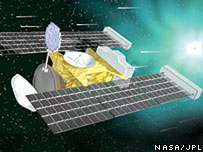
 In pictures