By Helen Briggs
BBC News science reporter |

 Stardust's capsule returns to Earth after a seven-year voyage |
US scientists are waiting for a capsule containing a teaspoonful of dust snatched from around a comet. The material was gathered by the Stardust probe in a seven-year, 4.8-billion-km (2.9 billion miles) interplanetary voyage.
The US space agency Nasa hopes the mission will give scientists their first chance to study pristine samples from the birth of the Solar System.
The capsule should land in the Utah desert at 0312 (1012 GMT) on Sunday.
Building blocks
Comets are thought to be cosmic "time capsules", containing material unchanged since the formation of the Sun and planets.
Some even think they may have seeded Earth with the chemical building blocks required for life.
"The goal of Stardust is to collect the original building blocks of the Sun, the planets and even ourselves," Don Brownlee, Stardust principal investigator at the University of Washington, Seattle, told reporters in Utah.
"When I look at the picture of a comet, what I see is a library that has picked up records of the Solar System and has been storing them away from the Sun for 4.5 billion years."
Gel trap
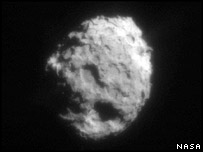
Stardust was launched on its mission to Comet Wild 2 in 1999. As part of its trip, the probe also captured a sprinkling of dust that would have originated in distant stars.
 | Stardust's mission: How Nasa's probe collected comet dust and will return it to Earth 
|
Stardust swept up particles from Comet Wild 2 in January 2004, as it flew within 240km of the "ice mountain". It did this by extending a retractable device containing cells filled with a material called aerogel, a porous substance designed to trap dust molecules.
One side of the collector was used for chasing the comet, the other for interstellar dust.
The container holding the samples will be jettisoned as Stardust flies back past the Earth on Sunday.
Daring descent
If all goes to plan, Stardust will release the capsule at 2257 on Saturday evening Utah time (0557 GMT Sunday).
About four hours later, the capsule will enter the Earth's atmosphere 125km (410,000ft) over the Pacific Ocean and fall 10 times faster than a speeding bullet.
The fall to Earth is expected to be visible from parts of the American northwest as a streak of light in the sky.
At about 32km altitude (105,000 feet), the capsule will release a small parachute to slow its descent.
The main parachute will open at about 3km (10,000ft), and bring the capsule down to a soft landing on a military base southwest of Salt Lake City.
World first
The samples will be picked up by helicopter and flown to an army building, then to a special lab at Nasa's Johnson Space Center in Houston, Texas.
|  This will help us understand how the Sun and the planets formed, and what they formed from This will help us understand how the Sun and the planets formed, and what they formed from |
Several research groups around the world are waiting to analyse the material, including planetary experts at the Open University, UK. Dr Ian Franchi, of the Planetary and Space Science Research Institute, said it was a fantastic opportunity.
"This is the first planetary material brought back from beyond low-Earth orbit for 30 years - since the Apollo and Russian lunar samples," he told the BBC News website.
"The stuff from the comet is as it was 4.5 billion years ago when everything in our Solar System formed.
"This will help us understand how the Sun and the planets formed, and what they formed from."
Genesis mission
Dr Franchi's research group has been trying to recover samples from the ill-fated Genesis mission, which collected in a similar way particles that had been blown off the Sun.
The Genesis capsule crashed into the Utah desert last September when its parachute system failed to open.
| Stardust returned 72 images from its encounter
|
The mission was not a complete failure, however, as researchers have been able to extract precious atoms from the smashed remains of the sample chamber. Pre-launch tests of Stardust's capsule suggest it does not suffer from the same flaw that afflicted Genesis.
"The spacecraft has been checked out to the nth degree after the Genesis crash," said Dr Franchi.
"Assuming that all goes well, it is a much simpler landing scenario than the Genesis mission, the weather conditions are favourable and we are hopeful of getting some fantastic samples to work with in the next few weeks."


 One-Minute World News
  News services
 E-mail this to a friend
  Printable version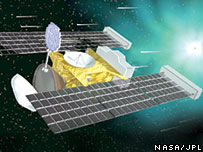
 More details