By Dr David Whitehouse
BBC News Online science editor |

Into the deep: Other telescopes will now follow up the study 
|
The Hubble Space Telescope has obtained the deepest view of the cosmos, detecting the oldest and most distant galaxies seen by astronomers. The Hubble Ultra Deep Field is the result of a prolonged look over four months at just one small patch of sky.
This historic image takes astronomers close to the Big Bang itself, unveiling the first galaxies that emerged from the end of the so-called "dark ages".
The image is expected to be unsurpassed until a new telescope is put in orbit.
Prolonged exposure
To produce the image, Hubble peered at the same point in the heavens for periods of many minutes between 24 September 2003 and 16 January 2004. In what amounts to a million-second-long exposure, some of the first galaxies that developed after the Big Bang can be seen. This was a time in cosmic history when the first stars were reheating a cold, dark Universe.
When the observations ended, Steven Beckwith, director of the Space Telescope Science Institute, told BBC News Online: "We have seen things that are fainter than anyone has ever seen before." The Hubble Ultra Deep Field (HUDF) contains an estimated 10,000 galaxies.
It is centred on the constellation Fornax, next to the constellation Orion. In ground-based images, the patch of sky (just one-tenth the diameter of the full Moon) is largely empty.
But the Hubble image, according to Dr Beckwith, is "just beautiful - rich, with many different, intriguing things".
Two deep images
This historic view is actually a combination of two separate images taken by Hubble's Advanced Camera for Surveys (ACS) and its Near Infrared Camera and Multi-object Spectrometer (Nicmos).
 | HUBBLE'S LONGEST LOOK Took Hubble 400 orbits to build ultra deep field observation ACS snapped 800 exposures; each averaged 21 mins long Total time amounted to 11.3 days of continuous viewing Most distant light detected at rate of 1 photon per minute |
Both images reveal galaxies that are too faint to be seen by ground-based observatories, or even in Hubble's previous faraway looks, called the Hubble Deep Fields (HDF), taken in 1995 and 1998. The final ACS image is studded with a wide range of galaxies of various sizes, shapes, and colours.
There is also a "zoo" of oddball galaxies littering the field. A few appear to be interacting. Their strange shapes are different from the spiral and elliptical galaxies we see today.
These unusual galaxies chronicle a period when the Universe was more chaotic; order and structure were just beginning to emerge.
The Nicmos sees even farther than the ACS. It reveals the farthest galaxies ever seen, because the expanding Universe has stretched their light into the near-infrared portion of the spectrum.
Object identification
"Nicmos provides important additional scientific content to cosmological studies in the HUDF," said Rodger Thompson, of the University of Arizona, and the Nicmos principal investigator.
 An edge-on spiral galaxy pictured close to an "oddball" blue galaxy |
The entire HUDF also was observed with the advanced camera's "grism" spectrograph, a hybrid prism and diffraction grating. "The grism spectra have already yielded the identification of about a thousand objects," Thompson added. "Included among them are some of the intensely faint and red points of light in the ACS image, prime candidates for distant galaxies," said Sangeeta Malhotra, of the Space Telescope Science Institute and the principal investigator for the Ultra Deep Field's ACS grism follow-up study.
"Based on those identifications, some of these objects are among the farthest and youngest galaxies ever seen."


 One-Minute World News
  News services
 E-mail this to a friend
  Printable version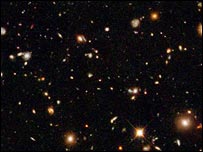
 Enlarge Image
 We have seen things that are fainter than anyone has ever seen before


