Click here to find out more about Nasa's new infrared telescope 
|
A $2bn space observatory that can study the early history of the Universe has been launched by the US space agency (Nasa).
It follows in the footsteps of the famous Hubble, Chandra and Compton observatories.
The Space Infrared Telescope Facility (SIRTF), as it is called, will detect infrared energy (heat) emitted from stars, galaxies and planets.
Astronomers will be able to study distant objects hidden by gas and dust that cannot be detected with visible light telescopes.
The observatory was launched into space on a Boeing Delta II rocket from Cape Canaveral, Florida, late on Sunday, local time (early Monday, BST).
An hour later, engineers received the first data from the space craft via the Nasa Deep Space Network in Australia.
"All systems are operating smoothly, and we couldn't be more delighted," said David Gallagher, project manager for the mission at Nasa's Jet Propulsion Laboratory in Pasadena, California.
Deeper, further
SIRTF is the largest, most sensitive, infrared telescope ever to be sent into space.
It will orbit for two to five years, drifting ever further into deep space.
 The telescope is the last of Nasa's 'Great Observatories' |
UK astrophysicists will be among those making use of the observatory. They will survey the sky for infrared galaxies found up to 10 billion light years away. "It allows us to look through dust," says Dr Sebastian Oliver of the Astronomy Centre at the University of Sussex. "This allows us to study objects that would otherwise be hidden."
Astronomers will be able to look back to a time when the Universe was a very violent place and many new stars were being born.
Michael Rowan-Robinson of Imperial College London says they will be able to look far deeper in the infrared than any previous survey.
"By looking back through almost 90% of the Universe's history, we shall be able to look back to a period when star formation was much more frequent than it is today," he says.
"This will enable us to trace the evolution of star formation from very early times."
New horizons
The launch of SIRFT marks the completion of Nasa's Great Observatories Program.
The Hubble Space Telescope, the Chandra X-ray Observatory and the Compton Gamma Ray Observatory study the Universe at other wavelengths.
Two are still in operation but Compton was taken out of commission in June 2000.
The European Space Agency is launching a larger infrared telescope - Herschel - in 2007.


 One-Minute World News
  News services
 E-mail this to a friend
  Printable version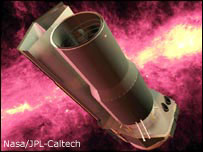
 At-a-glance

