
|
 |
 | | | | | | |||||||||||||||||||||||||||||||||||||||||||||||||||||||||||||||||||||||||||||||||||||||||||||||||||||||||||||||||||||||||||||||||||||||||||||||||
| | | You are in: Science/Nature | |||||||||||||||||||||||||||||||||||||||||||||||||||||||||||||||||||||||||||||||||||||||||||||||||||||||||||||||||||||||||||||||||||||||||||||||||||
|
| | Thursday, 1 August, 2002, 16:32 GMT 17:32 UK Clues to missing matter 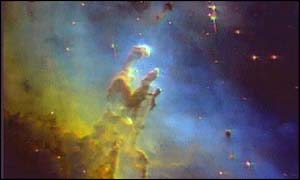 More than 90% of the Universe is "missing"
Scientists think much of the dark matter that theory tells us must exist in the cosmos - but can't be seen - may be hidden there. The gas detected by Chandra could contain more matter than all the stars put together - and probably traces the presence of the Universe's more massive dark matter component. Piecing together Four teams of US scientists used Chandra to detect super-hot clouds of gas, at temperatures up to five million degrees Celsius. The gas is thought to form part of a mesh of filaments that connect clusters of galaxies, the "cosmic web". "Computer simulations have been telling us for several years that most of the 'missing' gas in the Universe should be in hot filaments," says Smita Mathur, leader of the Ohio State team, in a press statement. "Most of those filaments are too faint to see, but it looks like we are finally finding their shadows." 'Significant finding' The discovery brings astronomers a step closer to explaining one of the biggest puzzles in modern astronomy - why more than 90% of the Universe is invisible.
"The result here is significant in that it is giving a 'tracer' to the dark matter within the Universe," says Nigel Smith, a researcher at the Rutherford Appleton Laboratory in Didcot, Oxfordshire, UK. "This can then be used to check the different models of the formation of the Universe, which themselves allow us to predict the make-up of the Universe," he told BBC News Online. Rotating clue Mark Wilkinson of the Institute of Astronomy at Cambridge University, UK, says the Chandra results, which appear as separate papers in the Astrophysical Journal, represent a "significant finding". "It's another confirmation that our basic picture of how the large scale structure of the Universe formed is correct," he told BBC News Online. Igor Liubarsky of the astrophysics group at Imperial College, London, UK, says it's a very exciting discovery. "This is indirect evidence of dark matter," he told BBC News Online. Scientists know from the way galaxies are rotating that a greater gravitational influence is at work in the Universe than can be explained by the pull of the ordinary matter that is visible. Scientists speculate the unseen dark matter is responsible for the galaxies' behaviour. Several observational techniques have now hinted at its presence. Some researchers suspect this strange matter takes the form of exotic sub-atomic particles - but none has so far been directly detected. | | See also:  10 Apr 02 | Science/Nature 22 May 01 | Science/Nature 09 Mar 00 | Science/Nature Internet links: The BBC is not responsible for the content of external internet sites Top Science/Nature stories now: Links to more Science/Nature stories are at the foot of the page. | |||||||||||||||||||||||||||||||||||||||||||||||||||||||||||||||||||||||||||||||||||||||||||||||||||||||||||||||||||||||||||||||||||||||||||||||||
| |
|  E-mail this story to a friend E-mail this story to a friend |
| |
| Links to more Science/Nature stories |
| | | ||
 | ||||
 | | Back to top
| ||
| ---------------------------------------------------------------------------------- To BBC Sport>> | To BBC Weather>> | To BBC World Service>> ---------------------------------------------------------------------------------- © MMIII | News Sources | Privacy |






