|
 |
 | | | | | | ||||||||||||||||||||||||||||||||||||||||||||||||||||||||||||||||||||||||||||||||||||||||||||||||||||||||||||||||||||||||||||||||||||||||||||||||||||||||||||||||||||||||||||||||||
| | | You are in: Science/Nature | ||||||||||||||||||||||||||||||||||||||||||||||||||||||||||||||||||||||||||||||||||||||||||||||||||||||||||||||||||||||||||||||||||||||||||||||||||||||||||||||||||||||||||||||||||||
|
| | Sunday, 8 September, 2002, 04:57 GMT 05:57 UK Test for Einstein's gravity speed theory 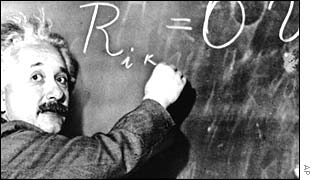 Einstein: His ideas are being checked experimentally
Thanks to a useful planetary alignment, physicists hope to test the general theory of relativity.
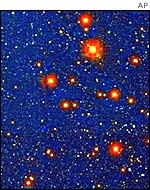
Scientists hope this will enable them to test one of Einstein's assumptions, that the speed of gravity is equal to the speed of light (300,000 km/s or 186,000 mps). Jupiter's gravity should nudge the light coming from the quasar, causing it to appear to shift a little in the sky. Astronomers hope to be able to measure this displacement, which depends on the speed of gravity. Einstein's assumption appears to be true, based on indirect evidence, but has never before been proven. Virgin Islands to Hawaii Scientists hope to measure the deplacement by comparing the quasar's position with that of other quasars that are far away from Jupiter as seen on the sky. Observations will be carried out using telescopes located in the Virgin Islands, Hawaii and Germany. They include 10 Very Long Baseline Array (VLBA) radio telescopes run by the US National Radio Astronomy Observatory (NRAO) and the Max Planck Institute's radio telescope in Effelsberg.
The team, led by Sergei Kopeikin of the University of Missouri-Columbia, US, will not get another chance for a decade. "We believe the general theory of relativity is correct and that the speed of gravity is equal to the speed of light," says Dr Kopeikin. "Japanese and Nasa scientists also will be looking as well using other telescopes around the world, so we'll be able to compare our findings." Curved space Researcher Ed Fomalont, an astronomer at the NRAO, says there could be some surprises in store. "If we find that the speed of gravity is faster than the speed of light then Einstein's theory of general relativity breaks down," he told BBC News Online. The idea of testing whether gravity acts at the speed of light is an intriguing one, says Michael Rowan-Robinson, an astrophysicist at Imperial College, London, UK. "Einstein's general theory of relativity is so dominant that we all assume gravity acts at the speed of light," he says. "But this does need to be tested."
"From Einstein's theory of gravity, that is his general relativity theory, we believe mass curves space and this can cause light to follow a curved path," he told BBC News Online. "The first test of general relativity was to observe the bending effect of the Sun's mass on distant stars during an eclipse - Sir Arthur Eddington in 1919 showed that the position of stars in the sky moved depending on whether the Sun was near their line of sight. "The amount they moved was close to the general relativity prediction, confirming that Einstein's theory was on the right track." He says the new experiment will do much the same thing using Jupiter instead of the Sun and quasars instead of stars. Many quasars emit strongly at radio wavelengths, so can be tracked very accurately by radio telescopes. "This means that by watching what happens to the positions of the quasars on the sky as the gravitational field of Jupiter moves past their line-of-sight, the scientists can test other aspects of the general relativity theory," says Professor Shanks. Relativity questions One aspect is to check how soon the gravitational, space-curving, effect of Jupiter is "felt" by the space around it, through which the quasar light is passing. This will be done by seeing if the movement of the quasar positions caused by Jupiter's space curving effect follows the predictions of general relativity. "If they do, then this will be a proof that gravity's space-curving effect is transmitted at the speed of light," he adds. "If the quasar positions do not move according to the prediction of general relativity then it will suggest that gravity's space-curving effect transmits at some other speed and place a question mark against the whole of Einstein's theory of general relativity." | |
See also:  01 Aug 02 | Science/Nature 05 Jan 01 | Science/Nature 08 Aug 02 | Science/Nature Internet links: The BBC is not responsible for the content of external internet sites Top Science/Nature stories now: Links to more Science/Nature stories are at the foot of the page. | ||||||||||||||||||||||||||||||||||||||||||||||||||||||||||||||||||||||||||||||||||||||||||||||||||||||||||||||||||||||||||||||||||||||||||||||||||||||||||||||||||||||||||||||||||
| |
|  E-mail this story to a friend E-mail this story to a friend |
| |
| Links to more Science/Nature stories |
| | | ||
 | ||||
 | | Back to top
| ||
| ---------------------------------------------------------------------------------- To BBC Sport>> | To BBC Weather>> | To BBC World Service>> ---------------------------------------------------------------------------------- © MMIII | News Sources | Privacy |