
|
 |
 | | | | | | |||||||||||||||||||||||||||||||||||||||||||||||||||||||||||||||||||||||||||||||||||||||||||||||||||||||||||||||||||||||||||||||||||||||||||||
| | | You are in: Science/Nature | |||||||||||||||||||||||||||||||||||||||||||||||||||||||||||||||||||||||||||||||||||||||||||||||||||||||||||||||||||||||||||||||||||||||||||||||
|
| | Thursday, 1 August, 2002, 14:53 GMT 15:53 UK Hubble sees 'space burger' 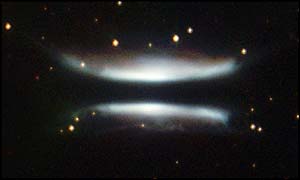 Cosmic recipe: Hidden star, glowing gas and dust
The latest object to be imaged by the Hubble Space Telescope is a sun-like star nearing the end of its life. It has already expelled large amounts of gas and dust and is on its way to becoming a colourful, glowing planetary nebula. The peculiar shape results from the way light plays with the ejected gas and dust. The "meat" in the burger is actually the shadow of a thick disc of dust around the central star. Above and below The central star itself, even though it is very hot, with a surface temperature of approximately 10,000 degrees Celsius (18,000 degrees Fahrenheit), is not visible, being hidden within the dust disc. However, light from the star does emerge in the directions perpendicular to the disc and illuminates the dust (the "bread") above and below. The reason why the star is surrounded by a thick, dusty disc is a mystery. Researchers say it is possible that the central object is actually a pair of stars. If so, then the star that ejected the nebula may be rapidly rotating, expelling material from its equatorial zone. Early stage Stars like our Sun end their lives as planetary nebulae. They first become swollen red giants and then eject their outer layers into space, exposing their hot cores. Intense ultraviolet radiation from these exposed remnants then streams out into the surrounding ejected gas, causing it to glow. The glowing gas is called a planetary nebula, so-called because to early observers this kind of structure looked like a small planetary disc. Gomez's hamburger, as this object is called, is referred to as a proto-planetary nebula, as it is in a stage of evolution immediately before the true planetary-nebula stage. Foggy night Just after a red giant expels its outer layers, the remnant star in the centre is still relatively cool. Consequently, it emits ordinary visible light - and very little ultraviolet light. Therefore the surrounding gas does not glow. But the ejected material also contains vast numbers of microscopic dust particles, which can reflect the starlight and make the material visible. This same effect of light scattering produces halos around streetlights on a foggy night. The lifetime of a proto-planetary nebula is very brief. In less than a thousand years, astronomers expect the central star here to become hot enough to make the dust particles evaporate and expose the remnant to view. Then the starlight will have eaten the hamburger and the object will become a glowing planetary nebula. | | See also:  23 Jul 02 | Science/Nature 06 Jun 02 | Science/Nature 30 Apr 02 | Science/Nature Internet links: The BBC is not responsible for the content of external internet sites Top Science/Nature stories now: Links to more Science/Nature stories are at the foot of the page. | |||||||||||||||||||||||||||||||||||||||||||||||||||||||||||||||||||||||||||||||||||||||||||||||||||||||||||||||||||||||||||||||||||||||||||||
| |
|  E-mail this story to a friend E-mail this story to a friend |
| |
| Links to more Science/Nature stories |
| | | ||
 | ||||
 | | Back to top
| ||
| ---------------------------------------------------------------------------------- To BBC Sport>> | To BBC Weather>> | To BBC World Service>> ---------------------------------------------------------------------------------- © MMIII | News Sources | Privacy |





