HARDtalk interview with Sule Lamido
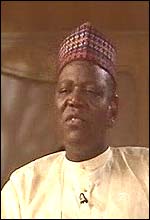
Transcription of Mike Embley's BBC Hardtalk interview with Alhaji Sule Lamido in London, shown on BBC World on 4 November 2002
Please credit HARDtalk and BBC World if printing extracts.
MIKE EMBLEY:
Today Hardtalk meets a Muslim who was imprisoned for his political beliefs but now finds himself part of a government grappling with the brutalities of sharia law and a country split by religious tension.
His country, Nigeria, is the most populous in Africa but it is also a leading Commonwealth nation. Its Foreign Minister is here in London to meet his counterparts, so we'll be asking him about the international fears for Zimbabwe and Pakistan.
MIKE EMBLEY:
Sule Lamido, welcome to HARDtalk.
SULE LAMIDO: (Nods)
EMBLEY:
You are a man of the Left. You were imprisoned by the former Nigerian dictatorship. An anti establishment figure, you have suffered at the hands of the establishment. Do you not find yourself uncomfortable now to be part of a government that sends in troops to deal with people in civil unrest and deal with them with extreme bloodshed?
LAMIDO:
It all depends on what you mean by a government sending in troops. You know, a government has to be responsible. A government has a clear role and a function and a duty under the constitution and therefore, where events are getting out of hand it is only normal that we evoke whatever means available at our own disposal to control situations and....
EMBLEY: (INTERUPTS)
I know you must speak for the government. I'm trying here, if you can, to get to the man. I'm thinking of the incidents in Benue State in October last year. Nineteen soldiers were killed by local militias that your troops went in and killed more than 200 unarmed civilians in reprisals. Were you comfortable with that?
LAMIDO:
When you have a situation of crisis, it is very difficult to anticipate what will be the end consequences. Your primary duty is first at least to control situations.
EMBLEY:
Well your President anticipated it. He defended it. He said "soldiers are trained to kill. That's what they do."
LAMIDO:
It has to be seen in the context of which it was said at that time. It has to be seen also in the context of what the troops were saying at the time. He is a former soldier and if you ask him an apportionate question he is going to give you an apportionate answer.
EMBLEY:
Isn't it perhaps the case that your government had little choice but to let the army make that show of strength because senior military officers in Nigeria hold too much power to be ignored?
LAMIDO:
What happened at that time, with the law was a very, very serious crisis. A number of people were dying and it was going beyond the capacity of the Nigerian police and indeed, other agencies to control and the military had to be called in. And that's what we did.
EMBLEY:
I ask because, I think viewers will be interested. You were a prisoner of conscience under the Nigerian dictatorship. In 1998 the US State Department put out, officially, a statement criticising your detention, calling for your release. Since then, as a government Minister, you've found yourself defending America's, your Presidents decision to join the US coalition on terror, defending America's bombing of Afghanistan. That's caused you some problems at home hasn't it?
LAMIDO:
Well, I understand how you see it. Yes, there may be some problems of perception...
EMBLEY:
Well it's not how I see it. Muslim crowds in your home town Kano tried to burn down your home.
LAMIDO:
That was a political....(PAUSES)...thing. It was not a correct reflection of what happened. Nobody burnt my house.....
EMBLEY:
(INTERUPTS) But they tried.
LAMIDO:
Nobody tried to burn my house. Nobody did.
EMBLEY:
Your national newspapers certainly reported that. What I'm moving on to is that Kano is one of twelve strongly Islamic states. It is your home state. You would describe yourself as a follower of Islam?
LAMIDO:
I am a Muslim by whatever definition.
EMBLEY: Would you describe Nigeria as an Islamic state?
LAMIDO:
Nigeria is a country which is multi religious. Where we therefore respect the right of each and every Nigerian to practice his own religion without any hindrance.
EMBLEY - You have twelve of Nigeria's northern states now under sharia law, including your home state. That, in population terms, amounts to more than half of Nigeria's population.
LAMIDO:
Yes.
EMBLEY:
With that come very strict punishments. Amputations, stonings, floggings. Are you comfortable with that?
LAMIDO:
I don't think it is the question of my own personal comforts. It is the comforts of the rights of Muslims to practice their own religion, and therefore submit themselves to the core of Islam.
EMBLEY:
But you serve in this government. You are a senior figure in this government, that administers the this country where these things go on.
LAMIDO:
This government cannot take away from me my own personal religious sentiments, no matter what. It is true that I am the Foreign Minister. It is true that I am supposed to reflect the governments policy, but then I am also a Muslim and there is nothing that can take away from me, the thoughts of my religion....from me.
EMBLEY:
You talk about the crisis in Benue state just now as if it is a crisis that has passed but it is the case, isn't it, that sharia law, the situation in the Islamic states, is contributing greatly to the tensions between the largely Christian south and the largely Islamic north in your country.
LAMIDO:
I think this is a part of this, you know, misunderstanding or deliberate distortion of events in Nigeria..
EMBLEY: (CUTS IN)
Where is the misunderstanding? In the past three years ten thousand people have died in your country in common or religious conflict.
LAMIDO:
(LAUGHS) But then you see, I do agree that there has been a lot of unrest but that did not begin from this administration. Even in the past, there has been civilian unrest. There have been crises in Nigeria. You have to know our internal chemistry where there is so much poverty and also (INAUDIBLE)....elite and therefore who are willing to manipulate everything. Including religion.
EMBLEY:
But very recently five hundred dead in clashes between Muslims and Christians in Jos. Two thousand in Kaduna.
LAMIDO:
No. It's not between Muslims and Christians, no. In Jos, no. It is a political issue. It is differences between nomadics and settlers and indegenes and it's all part of the economics of the poverty of the Third World.
EMBLEY:
Well, it is a problem for your government isn't it. That sharia makes Christians nervous. Even though they are exempt from the punishments, it makes them nervous. They wonder what is to come.
LAMIDO:
People should understand the religion first. You should understand that Muslims have their own code of religion and they are willing to submit themselves and really, therefore, whatever happens should be seen in that context. It is not fair for you to (INAUDIBLE) that so and so called it primitive, it's barbaric, because you are simply antagonising the question.
EMBLEY:
It's a difficult question for you because the same US State Department that sought your release under the dictatorship now warns Americans not to go to your country.
LAMIDO:
I don't really feel that you are properly situating your question in context. At that time, they were asking for a democracy in Nigeria..
EMBLEY:
(INTERUPTS) This is now. This was August 8th this year.
LAMIDO:
I am coming to it. At that time they were asking for a democracy in Nigeria. The government was headed by a Muslim, like me, from my own area, like me and who was literally tyranising the whole country. It is based on these values which the American government then acted.
What you have in that country states what we have in our own constitution. To make laws on such aspects which guarantee the right to the religion which they want to practice and because it is part of our own constitution.
Therefore these laws are legitimate and they are right and should not be submitted by any other passing of personal emotional interpretation. What we have are people looking at those laws from a very jaundiced point of view.
EMBLEY:
Well look at it as it happens on the ground. If you condone sharia law, you condone a pregnant woman recently found guilty of having pre-marital sex being sentenced to death by stoning. A woman who complained of rape being found guilty of fornication and given one hundred lashes. This is alright with you?
LAMIDO:
Because I am a Muslim and because this is the code of the religion, therefore it is foreign. Conversely, there are a number of things which you do that we find here very weird, which we don't accept, which we don't understand. But because they are your own way of life, we accept them.
EMBLEY:
It is hard for people to understand, but surely you have to make a decision whether there is a modern Nigeria or if there will be a sharia law Nigeria.
LAMIDO:
Modern Nigeria cannot impede the rights of Muslims to be Muslims.
EMBLEY:
So this will go on.
LAMIDO:
Absolutely.
EMBLEY:
So, as a cabinet minister you will allow part of your country to be governed by different laws to the ones your government puts forward?
LAMIDO:
As a Minister of government, I am prepared to follow the general constitution which gives each and every Nigerian the right to practice the religion of his own choice.
EMBLEY:
Your Junior Foreign Minister, your International Ambassador for Tourism, John Fashanu all say that this woman will not be stoned to death.
LAMIDO:
We have provisions by which we can make appeals.
EMBLEY:
Will it happen?
LAMIDO:
I think so.
EMBLEY:
You think the stoning to death will happen?
LAMIDO:
I think she will go through the normal process of our laws and the courts in their own wisdom may decide to acquit her.
EMBLEY:
Why do you not have the guts to stand up to the Sharia states?
LAMIDO:
Because I am a Muslim, I cannot stand up here and simply....
EMBLEY:
(INTERUPTS) - But you are the man who can do it, are you not?
LAMIDO:
I don't know if you really understand my role. Before I am a Minister I am first and foremost a Muslim and I will remain a Muslim after I have left the Ministerial position.
EMBLEY:
As a Muslim, you accept that this must happen. As a modern Nigerian is this the face you want for modern Nigeria?
LAMIDO:
Modernity should not undermine ones faith; be it Christianity, Islam or traditional religions.
EMBLEY:
(SIGHS) I was going to say it's make your mind up time, but you've made your mind up haven't you?
LAMIDO:
I don't quite follow you.
EMBLEY:
What face do you want Nigeria to present to the World. You have decided that Sharia law must stay. That people must be stoned to death, have their limbs amputated.
LAMIDO:
You can say whatever you want to say, but I am a Muslim. I stand by Islam. If I have committed any fornication, I will also equally submit myself to that religion.
EMBLEY:
Do you see what's happening in Zimbabwe as a good advertisement for modern Africa?
LAMIDO:
It all depends on who is talking and who is saying so.
EMBLEY:
I'm asking you.
LAMIDO:
You are asking me. I can see your own feelings because it's coming from you.
EMBLEY:
I am asking you because as you know very well, much better than me, Nigeria could do something about what is happening in Zimbabwe on behalf of the Commonwealth. The entire Commonwealth gave Nigeria that power along with South Africa and Australia.
LAMIDO:
I am at odium to understand the emotional perspective by which you look at things here in Western Europe. The case of Zimbabwe has got a very, very clear history. Your current emotions belie your earlier policy as a colony.
EMBLEY:
Still?
LAMIDO:
It is so pleasing that you are becoming so concerned about our dignity, about our security, about us being people, us being a culture, us being a race, us being a civilisation.
EMBLEY:
I have no wish, Sir, to offend your dignity. I respect your dignity. I put to you the words of other Africans. Morgan Tsvangarai , the leader of the main opposition in Zimbabwe, he told us..
LAMIDO:
(INTERUPTS) In the history of your own country there is no reflection that you have that same respect for human dignity.
EMBLEY:
Sir, I'm not here to defend that.
LAMIDO:
Beautiful!
EMBLEY:
Can I put this to you? You have praised President Obasanjo so hard, in your own words, as Africa's chief advocate. Morgan Tsvangarai told us "There is an increasing failure on the part of African leaders to appreciate the plight of the Zimbabwean people as a result of Mugabe's actions". Who do you think is right?
LAMIDO:
Morgan Tsvangrai is a politician. He has got a political party and he wants to win votes and therefore, whatever ploy or mechanism he employs, you know, to illicit support for his own political post, I will have no problem with.
EMBLEY:
Mr Lamido. You are obviously a highly intelligent man. You are a man of principles. Imprisoned by a dictator for your principles. Are you going to tell all these viewers that you believe that what Mr Mugabe is doing is in the best interests of his country?
LAMIDO:
It all depends on who holds the view. Go to Africa. Ask the Africans.
EMBLEY:
What do you believe?
LAMIDO:
Because I have got a very clear understanding of the historical situation of Zimbabwe (INAUDIBLE)......of how I see it now.
EMBLEY:
The Commonwealth observers concluded that the Zimbabwean Presidential elections, in their words, "did not adequately allow for a free expression of will by the electors".
Your observers endorsed the elections saying that they saw nothing that threatened the integrity of the poll. Now, were these observers blind? Were they stupid? Were they hopelessly terrified? How bad does it have to get?
LAMIDO:
I think the African observers were genuine, were honest, because they were having to relate events to actual situations on the ground.
EMBLEY:
You're talking context again aren't you? Context makes it alright.
LAMIDO:
On the contrary, the European observers and others try to apply parameters or indices which are totally unrelated to events on the ground there, because your own kind of development level - your status, your institutions cannot be compared to that of Africa.
EMBLEY:
For any change in Africa, through NEPAD or anything else, Zimbabwe is a problem for you. Let's stick to what you've asked for to happen. The Troika, the three countries that the Commonwealth gave the power to called for reconciliation, to..
LAMIDO:
(INTERUPTS) You cannot begin to confuse NEPAD with Zimbabwe.
EMBLEY:
No, but it is an embarrassment for you. Let me just put this to you. The three countries....
LAMIDO:
(INTERUPTS) There are 54 sovereign countries under the African Union. You are taking only one country. Only one country to judge us. You are not being fair.
EMBLEY:
But you know why. People are starving. People are being beaten. People are being killed there. For their beliefs.
LAMIDO:
I find your concern and your wonderful sympathy for Africa very, very amusing. In Africa people die every second out of AIDS.
EMBLEY:
Yes.
LAMIDO:
They die out of famine. Out of hunger. They are diseases. We have not seen this kind of concern of yours which is so humanitarian, so manifest on issues that are so very, very fundamental. There are the killings in Rwanda also....
EMBLEY:
(CUT IN) The point is, this is a place that you can do something about. The Troika said "We want reconciliation between political parties in Zimbabwe". Morgan Tsvangarai is facing trial for treason. Will you let that go ahead?
LAMIDO:
You are taking events of only three years which began as purely bilaterally between Britain and Zimbabwe, which were then elevated to a national concern and into a democracy and into other core values and here we are today being blackmailed simply because an issue that was purely bilateral and because its own chemistry and (INAUDIBLE) were endangered by Zimbabwe. Well, thank you very much..
EMBLEY:
In May, it was reported that you met Robert Mugabe yourself. That you had an enlightening discussion. That you gave him a special message from your President. Would you enlighten us - what did he tell you? What did you ask of him?
LAMIDO:
I went to him and said to him that it is important that we reckon by international mood (?). It is very important that we begin to see how can we, based on this wrong perspective, how can we assist Zimbabwe to treat this issue of white farmers.
EMBLEY:
May I ask what he told you?
LAMIDO:
He said (PAUSES) Mr Lamido, the history of Zimbabwe is very, very clear. When we were looking for our independence, in the constitution there was a provision which for ten years we couldn't even alter. Even though we were a sovereign country.
It is not enough for us to have this independence but we need a piece of land to be able to raise our own flag. So, for ten years they couldn't alter their own constitution, because it is part of the thing planted in there.
So, when they can do it later on they said "slow down because we are waiting for South Africa to be independent". So everything Mugabe was doing was also determined and governed by other African interests somewhere.
EMBLEY:
But the situation now is disastrous isn't it? You told a television interviewer two years ago, I have a quote here - you said "The West are the cause of all our problems. Africa was a colony. Our culture, our history, civilisation. We were all distorted. Our economies are appendages of the West".
LAMIDO:
Absolutely.
EMBLEY:
You see, what it looks like is what is holding up justice in Zimbabwe, what is causing people to starve in Zimbabwe is that you cannot or will not side with the old colonial masters even when they are right. That the white view is wrong simply because it is white.
LAMIDO:
You are being very unfair to me. I am not a racist.
EMBLEY:
But it's right.
LAMIDO:
You have to understand the history of Africa. You know, there is starvation in many places in Africa.
EMBLEY:
This is a place that you undertook to fix.
LAMIDO:
Granted, yes, but you see, your concern should be continental. There should be some democracy in this concern. That should be seen manifesting in other areas.
EMBLEY:
Let's broaden the issue. Let's look at Pakistan. You're here in London now with other Commonwealth leaders to discuss Pakistan. Pakistan, suspended from the Commonwealth. Just had elections. You've kept up Pakistan's suspension from the Commonwealth but only pending further examination of the democratic structures.
LAMIDO:
Yes.
EMBLEY:
This is a place with an acknowledged dictator. A man who can suspend Parliament and the Prime Minister if he wishes to. Where ballot boxes weren't sealed, where two senior politicians were barred. Again, I have to ask, how bad does it have to get?
LAMIDO:
I am glad you are saying that. I am really glad you are saying that thank you very much.
EMBLEY:
What is your opinion then, of President Musharaff? LAMIDO:
Well, you have just said it.
EMBLEY:
Your words are more important than mine....
LAMIDO:
In fact, to me it is a new revelation that there have been some manipulations, that there have been distortions, ballot boxes stuffed, that some people have been banned. So yes, it is true to me obviously what is happening in Pakistan is wrong and therefore we are right in taking our position on Pakistan.
EMBLEY:
So you accept that he is a dictator whose power is almost unlimited despite the election?
LAMIDO:
Elections. Before the elections, there was a referendum in which he alone was the only candidate, over his own government, which came in through a coup d'�tat and where the (INAUDIBLE)......alone gave him the power and he is going to be President for five years.
EMBLEY:
You will say this, you will agree, but you won't speak against Zimbabwe.
LAMIDO:
Zimbabwe is a creation of a democracy. Pakistan and Musharaf is not a creation of a democracy. This is the difference. Whatever may have been the imperfection there Zimbabwe's system came through a system which is democratic. It may not be the best of systems but in Pakistan it is not a democracy.
EMBLEY:
Can we move on. You've blamed the old colonial powers again for a very recent decision in the International Courts of Justice. It's just gone against you. The Bakassi Peninsula, which is, of course you will know, very rich in oil.
It's on your border with Cameroon. Long disputed. Now the highest judicial body of the United Nations has ruled that Bakassi belongs to Cameroon. Now your President has said "we never agreed to stand by that ruling".
LAMIDO:
You can see....your emphasis. You are focusing on the economics of it.
EMBLEY:
I wonder where the rule of law stands if suddenly you can choose to accept it or not accept it.
LAMIDO:
I can't imagine someone meeting Nigerians and deciding they should be somewhere else. People who are inhabiting Bakassi are Nigerians. They have been there from before the beginning of the beginning and they are part of our own constitution because the area is in our own constitution.
So, while we respect the integrity of the judges there are a number of things they have overlooked.
EMBLEY:
Your President now says that he never agreed to abide by the ruling, yet there are pictures of hi shaking hands with the President of Cameroon in front of Kofi Annan who agrees that there was an agreement.
LAMIDO:
If you can call Kofi Annan or President Paul Biya and ask them to swear on their honour that President Obasanjo said so then I will agree with you. Ask them. Kofi Annan was there, Paul Biya was there, we were all there. I don't know how you came by this sacrosanct commitment that we would do that. It was never said.
EMBLEY:
Kofi Annan says.....
LAMIDO:
(CUTS IN) He didn't say so. You see, a release coming from office, not signed by him, was signed by an officer.
EMBLEY:
Can I ask you. This is a real question for a politician - complicated but this will ultimately go to the UN Security Council if you do not accept the ruling of the UN's highest judicial authority.
If it goes to the Security Council, that is of course dominated by the United States, the US is a big player there, the suspicion is that with supplies of Middle East oil so shaky, with Bakassi being a very important oil region the US will somehow get you off the hook on this one. That you will be allowed to keep Bakassi because the US needs your oil. West Africa can supply as much oil as Saudi Arabia. Do you expect that to happen?
LAMIDO:
You see, the way we are living in Africa is outside the economics. We believe in humanity.
EMBLEY:
You are ducking the question. You know that economics can decide humanitarian issues.
LAMIDO:
It is not a question of oil. No. It is a question of Nigerians on the soil called Bakassi, who are Nigerians- who come under our protection.
EMBLEY:
You've come to the brink of war over this before. There have been several armed clashes. Do you expect to fight again?
LAMIDO:
We will not fight because there are more demanding things to be looked at. There are a number of things which are engaging Africans more than fighting over a small piece of land.
EMBLEY:
You blame the West in many ways. You blame the old colonial masters. Do you not think....
LAMIDO:
(CUTS IN) I am not blaming the West. I am simply reflecting into history.
EMBLEY:
Do you not think through that you give the impression, when you are doing this, that you play into the hands of the paternalists- racists if you like, who claim that Africans can't handle their own affairs.
Doesn't there come a point when you must admit ownership of these matters. You must acknowledge corruption and starvation in Zimbabwe. You must acknowledge mutilation in your own country. That these things Africans are doing to Africans - Africans can stop it.
LAMIDO:
That word corruption is not an African word. It is an English word "corruption", so it must have been here before it went back there.
EMBLEY:
Then again we seem to be blaming, but at what stage? At some stage you have to deal with it, do you not? You can't keep blaming it on the West.
LAMIDO:
Sir, sir, with all respect, you have to understand Africa first. Understand us, the way we are struggling. We are working very, very hard.
We want to be democrats. We want to be transparent. We want to do everything which will meet up to your own expectations, but then you have to properly assist us in doing that. Not by patronage, not by condescension, but by real engagement.
EMBLEY:Sule Lamido. Thank you very much.
LAMIDO:Thank you Mike.





 E-mail this story to a friend






 BBC News 24

