|
 |
 | | | | | | |||||||||||||||||||||||||||||||||||||||||||||||||||||||||||||||||||||||||||||||||||||||||||||||||||||||||||||||||||||||||||||||||||||||||||||||||||||||||||||||||||
| | | You are in: Programmes: From Our Own Correspondent | |||||||||||||||||||||||||||||||||||||||||||||||||||||||||||||||||||||||||||||||||||||||||||||||||||||||||||||||||||||||||||||||||||||||||||||||||||||||||||||||||||||
|
| | Saturday, 2 November, 2002, 15:44 GMT Colorado's quiet revolution  The Hispanic population is growing rapidly in the US A political revolution is afoot in Colorado. Hispanics - who are nationally Democratic voters - are now the key swing voters in one of the tightest Senate races. The BBC's Jonathan Marcus reports from Denver. A concrete shopping mall on the western outskirts of Denver is an unlikely setting for a political revolution. Indeed, Raoul Vasquez - a smiling man in his 50s wearing a sharply cut traditional Mexican costume - is an unlikely revolutionary.
Raoul Vasquez comes from a long-established Hispanic American family - devout and hard-working. He says that he was raised to be a Democrat but that the scandal of President Clinton's affair with Monica Lewinsky helped to change his mind. Essentially, though, it's not so much the scandal but the Republicans' traditional pitch for small business, opposition to big government and championing of tax cuts that won him over. Mexican sunshine Mr Vasquez runs what is more than just an ordinary family business. He, together with his wife, three daughters and two sons make up a musical troupe known as the Mariachi Vasquez. They were at the shopping mall in Lakeside - a Denver suburb - to rehearse for an annual Mexican Night of music that draws thousands of people.
There are some 735,000 Hispanic Americans in Colorado - nearly 18% of the population. In truth, despite the optimistic predictions of the Republican party workers, a significant majority of them are likely to stick to their traditional political allegiance and vote Democrat. Nationally, some 80% of the Hispanic or Latino population are Democratic voters. But here in Colorado at least there are signs of a modest shift, making Hispanics the key swing voters in this year's race. Democrats reach out Ada Diaz Kirby is deeply involved in the campaign to re-elect the Republican Senator Wayne Allard. A fashionable and voluble businesswoman, Ada is the epitome of the American dream. She came to the United States from Cuba when she was 11, leaving her parents behind. She passed through orphanages and foster homes - "the school of hard knocks" as she describes it.
The Democrats, too, have their Hispanic outreach and have eagerly been trying to ensure that as many members of the Latino population as possible are registered to vote. Colorado is rather different from the national average. Here only some 55% of Hispanics vote Democrat. The rest are split between the Republicans and independents. And the Democrats are as aware of the potential Hispanic swing vote as anyone else. The issues that matter here are the traditional bread-and-butter themes - housing, healthcare and pensions. Of course, there is unease about a slowdown in the economy and the threat of recession. Presidential authority There's deep disquiet about a potential war with Iraq - although most Hispanic Americans I spoke to, whatever their political leanings, seemed reconciled to at least the possibility of conflict. This is a strongly religious community that supports presidential authority. And if President Bush leads the nation into a war, then most Hispanic Americans will probably back him.
Also on the ballot paper is a range of so-called amendments - essentially referendum questions. One, of vital concern to Hispanic voters, is amendment 31 - an effort to limit bilingual education in Spanish and English. Its advocates believe that after an intensive English course, Spanish-speaking children should be placed into classes where all the teaching is conducted in English. This, they say, is the only way to ensure that youngsters from Spanish-speaking families master the vital language skills to gain a college education and get on. Changing face Critics say the amendment is racist. The campaign for a "No" vote is well funded and the amendment doesn't look like passing. Many - probably a majority of ordinary Hispanic voters - have been worried by it. But here, too, opinion is divided. Felipe Duran is the owner of the El Senor Sun restaurant. He is firmly against bilingual education, arguing that it lowers expectations for Hispanic children, some of whom leave high school without being fluent in English. Here it is again, the changing face of Hispanic America, a more diverse community, one better able to lobby on its own behalf. A community that both major parties realise could be pivotal in the coming election battle. And nowhere more so than here in Denver, the mile-high city, hard up against the foot-hills of the Rocky Mountains and at the centre of a demographic shift that could have profound political implications across the nation. | |
See also:  13 Mar 02 | Americas 30 Apr 01 | Americas Internet links: The BBC is not responsible for the content of external internet sites Top From Our Own Correspondent stories now: Links to more From Our Own Correspondent stories are at the foot of the page. | |||||||||||||||||||||||||||||||||||||||||||||||||||||||||||||||||||||||||||||||||||||||||||||||||||||||||||||||||||||||||||||||||||||||||||||||||||||||||||||||||||
 | |
|  E-mail this story to a friend E-mail this story to a friend |
|  |
| Links to more From Our Own Correspondent stories |
| | | ||
 | ||||
 | | Back to top
| ||
| ---------------------------------------------------------------------------------- To BBC Sport>> | To BBC Weather>> | To BBC World Service>> ---------------------------------------------------------------------------------- © MMIII | News Sources | Privacy |




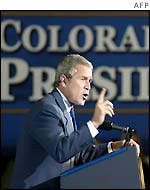
 A significant majority of Hispanics are likely to stick to their traditional political allegiance and vote Democrat