|
 |
 | | | | | | ||||||||||||||||||||||||||||||||||||||||||||||||||||||||||||||||||||||||||||||||||||||||||||||||||||||||||||||||||||||||||||||||||||||
| | | You are in: Programmes: Breakfast | ||||||||||||||||||||||||||||||||||||||||||||||||||||||||||||||||||||||||||||||||||||||||||||||||||||||||||||||||||||||||||||||||||||||||
|
| |  Wednesday, 14 August, 2002, 11:33 GMT 12:33 UK Wednesday, 14 August, 2002, 11:33 GMT 12:33 UK Declan's New York Diary: The Workings of Wall Street 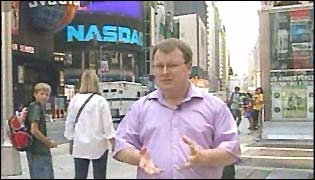 "The scene of the crime" is the NASDAQ says Declan They say that when America sneezes, Britain catches a cold. And, at the moment, the gloom of the American Stock Market is pushing down British share prices, despite the underlying health of our economy. That's why we've sent our Business Presenter, Declan Curry, to Wall Street. Here's the third part of Declan's New York Diary
In international publicity terms, this is the poor relation of the trading floors. The names "Dow Jones", "Wall Street", "New York Stock Exchange" and "NASDAQ" are all pretty much part of our everyday language. But Amex? Mention that, and most of us think of credit cards. But it's a big part of New York's financial community, and it does more than its famous cousins. AMEX trades shares, the rights to buy shares in the future, and a slice of trading activity on different stock exchanges around the world.
Street theatre And it also does a great street theatre. Trading is done the old fashioned way - in the confusion of yells, nods, nudges, hand signals and shouts that accompany the buying and selling. The main players strut around the floor in their bright jackets, like exotic birds preening in an aviary. Brokers co-ordinate the deals. The lucky ones lounge at a row of desks on the trading floor, all a mess of monitors, paper slips and coffee cups. The more nimble ones dart around the floor, their mobile headsets squawking with the latest deal, their eyes scanning the floor for the merest hint of a bargain. They get their orders from the ranks of desks up in the balconies. The occupants are tucked away like rabbits in a warren, but this is where the public and the financial institutions send their instructions. These get passed onto the floor by mobile phone, walkie-talkies or through the clumps of phones that sprout like trees along the floor. When the brokers get their orders, other market creatures flock around like vultures. The market makers are the Exchange's wholesalers. For the right price and the right volume, they've got the stocks someone wants to buy, or can take on the goods someone else wants to dump. And so the display begins - several times a minute, hundred of times a day. It's the sort of thing we used to have at the London Stock Exchange before the reforms of the 1980s. Now the City of London is barn-fulls of computer screens scattered as far apart as Canary Wharf and Victoria. Electronic trading has been good for those of us who own a handful of stocks - it keeps costs low and makes trading more convenient. But it has deprived us of some of the drama and excitement that used to surround share dealing. And it has stopped us from remembering that for all the jargon and fuss, share trading is just a hop, skip and a jump away from the local fruit and veg stall. It's all about trading - who's offering the right price, and who's got the juiciest fruit. Which reminds me of an amusing contrast on Wall Street last Sunday. The world's most famous stock exchange is on one corner, bathed in sunlight, imposing and magisterial. Across the road, there was a street trader, selling t-shirts to tourists from the back of a trailer. They're both markets - but what's the betting the t-shirt trader made more money than many of the investors inside the NYSE the previous week? Orchids Oh - by the way - remember those orchids I mentioned in yesterday's e-postcard? They were in the atrium of the World Financial Centre, on the southern tip of Manhattan. That place was pretty badly damaged during the terrorist attacks here last September - the buildings were close to the Twin Towers, and the atrium was wrecked when the Towers collapsed. Well, there's a heart-warming photo on the front of the New York Times. For the first time since the attacks, big plants have returned to the building. A giant palm tree has been replanted in the restored atrium, and improvements they've made during the renovation mean it - and its siblings - should enjoy more sunlight than before. While the City makes its preparations for the first anniversary of the attacks next month, it's also making what it can better than before. | | |||||||||||||||||||||||||||||||||||||||||||||||||||||||||||||||||||||||||||||||||||||||||||||||||||||||||||||||||||||||||||||||||||||||
|  |
|  E-mail this story to a friend E-mail this story to a friend |
| |
| Links to more Breakfast stories |
| | | ||
 | ||||
 | | Back to top
| ||
| ---------------------------------------------------------------------------------- To BBC Sport>> | To BBC Weather>> | To BBC World Service>> ---------------------------------------------------------------------------------- © MMIII | News Sources | Privacy |




 The noise. The smell. The bright colours. The boxes full of sandwiches and melon slices. Going behind the scenes at the American Stock Exchange is all a bit overwhelming.