|
 |
 | | | | | | |||||||||||||||||||||||||||||||||||||||||||||||||||||||||||||||||||||||||||||||||||||||||||||||||||||||||||||||||||||||||||||||||||||||||||||||||||||||||||||||||||||||
| | | You are in: Programmes: Breakfast | |||||||||||||||||||||||||||||||||||||||||||||||||||||||||||||||||||||||||||||||||||||||||||||||||||||||||||||||||||||||||||||||||||||||||||||||||||||||||||||||||||||||||
|
| |  Saturday, 17 August, 2002, 08:56 GMT 09:56 UK Saturday, 17 August, 2002, 08:56 GMT 09:56 UK Declan's New York Diary: King of the Nasdaq 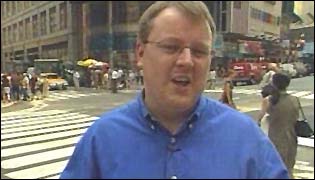 Today, Declan meets Wick Simmonds, King of the Nasdaq Our Business presenter Declan Curry has been on Wall Street for a week. He's been asking why does the state of the US stockmarket have such a dramatic impact on our own. In final part of Declan's New York Diary, he meets the King of the Nasdaq: the American high-tech shares index which has gone dramatically from boom to bust
Wick Simmons laughed, and said it was the best job he'd ever done. But he admitted he's said that about all his jobs. After spending close to an hour with him, I still don't know what thoughts go through your head when you're running one of the world's biggest stockmarkets. But two things are obvious - he has an awfully long working week, and he's finding it's more difficult to run a company in the bad times than it is in a boom. For a man with a new young family (he's in his 50s, his daughters from his current marriage are just turning teenagers), he certainly puts in the hours. The working day starts at 6am, and he's still on the go more than 12 hours later. And then he's got the decision no executive who's also a father of a growing family likes to make nowadays - to go to the evening dinners that are of crucial importance when you're doing business at the highest levels, or to go home to the kids? The call of the rubber chicken When he's got a free choice, the kids win every time. But at least two nights a week, he's on the rubber chicken circuit, and is lucky to see home before 10pm. He gives the impression that he'd rather see more of his children; he'd be forgiven if he said he'd like to see less of America. The job is split between the various Nasdaq offices along the east coast - if he's not in Times Square for that day's opening ceremony, he'll be downtown in its business headquarters just off Wall Street. Failing that, it's the Washington office for some top-drawer political schmoozing, or he'll be at one of the many share dealing companies that make up the Nasdaq (it is still a mutual exchange, owned by its members). That's all before you count in travel to other parts of the States, or even abroad - to the Nasdaq's operations in Japan, London or Berlin. He's likely to have less of that foreign travel to do in the future. The volatility on the markets has forced the Nasdaq to rein in its plans for a round-the-clock, round-the-world stock exchange. Reviving the Nasdaq His predecessor went on a dash for growth, building up inter-linked exchanges in Japan and Europe on the back of the tech boom. Now all that's been put on hold. The Japanese operation is almost certainly going to be shut down, and while the exchange is expanding in Germany, its Nasdaq Europe operation isn't as successful as had been hoped, and any idea of a deal with the London Stock Exchange has been put on the shelf - for now, at least.
PR offensive There are endless meetings, of course, but much of his job seems to be about public relations - keeping the member stock trading firms sweet, and re-assuring the public who've still got money in shares that they're not on a one-way ticket to destitution. That's why he spends so much time speaking to people like BBC journalists. He expects those investors who bailed out of the market with massive losses to come back - but he knows they need to be coaxed. And he recognises the damage that's been caused to all of capitalism by the sleaze that's oozing out of America's biggest companies. And he also says the Nasdaq has to re-invent itself. Being the home for technology shares was all very well during the tech boom, but now he's selling it as the home for all the companies that will build America's future. This is another one of those things that change when good times go bad. Brokers of the future We've spent all of the last week going behind the scenes at America's stock markets, and trying to measure the importance of shares to the national life over here. But we're not the only people over from the UK doing that. Four pupils from Tadcaster Grammar School have made the journey from York to New York this week. Adam Firth, Chris Wiseman, Andrew Jackson and Phillip Malloch are officially Britain's top student investors - they're this year's winners of the schools share-dealing competition, run annually by the financial education charity Proshare. The lads' prize was an all-expenses trip to New York, and a tour of the financial hot spots like the Nasdaq, the New York Stock Exchange and the Federal Reserve Bank of New York (its boss is one of the people who sets interest rates across the whole of the United States.) They came into the BBC's business bureau in the early hours of Friday morning to take part in the programme. Off camera, they said the thing that absolutely staggered them this week was the amount of money that swirls around the various stock exchanges here. Billions of pounds worth of shares are bought and sold every day, and billions more is soaked up in the currency, commodity, futures and options exchanges. The boys were also struck by the ease with which you can buy shares. There are stock shops every couple of blocks in Manhattan, run by the big financial institutions. Our business team here tell me the number of people using those high-street share stores has fallen in the last year. But any time I looked into one, they still looked pretty busy. And those two things are at the heart of everything we've been trying to explain this week - so many people own shares, and so much money is tied up on the markets, when share prices fall, Americans feel poorer, they spend less, companies do less trade, and the recession that started off in business spreads a little further up the high street. And when that happens, the rest of the world has to watch out, because we're all just pistons in the global economic engine. When the biggest piston of the lot seizes up, the engine stalls - no matter how well-designed or well-oiled our British piston is. Breakfast is back at the London Stock Exchange on Monday. | |
| |||||||||||||||||||||||||||||||||||||||||||||||||||||||||||||||||||||||||||||||||||||||||||||||||||||||||||||||||||||||||||||||||||||||||||||||||||||||||||||||||||||||
|  |
|  E-mail this story to a friend E-mail this story to a friend |
| |
| Links to more Breakfast stories |
| | | ||
 | ||||
 | | Back to top
| ||
| ---------------------------------------------------------------------------------- To BBC Sport>> | To BBC Weather>> | To BBC World Service>> ---------------------------------------------------------------------------------- © MMIII | News Sources | Privacy  |





 "What is it like, I asked him, "to be the boss of the Nasdaq?"