 | Click below to see the plastinated body slice exhibit 
|
An example of the controversial work of Gunther Von Hagens is to be put on permanent display at the new Wellcome Collection in London. The exhibit is a very thin slice of a human body which has been preserved using Von Hagens' pioneering plastination procedure.
Invented in 1977, the technique allows close study of the body's anatomy.
Twenty million people world-wide have visited Von Hagens' plastination exhibition, Body Worlds.
The plastination process involves replacing the natural body fluids with synthetic materials such as silicone rubber, epoxy resin or polyester. Once preserved the bodies are highly durable, but still retain the natural surface structure.
However, Von Hagens' work has attracted criticism for being shocking, and blurring the boundaries between science and entertainment.
The new exhibit will be displayed alongside a number of modern artworks relating to human health and wellbeing in the Wellcome Collection's Medicine Now gallery.
The Body Worlds exhibition, which features over 200 plastinated bodies and organs, attracted 850,000 visitors alone when it came to London between March 2002 and February 2003.


 One-Minute World News
  News services


 E-mail this to a friend
  Printable version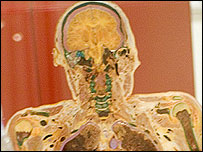
 Enlarge Image


