Bulgaria joins the European Union on 1 January 2007, along with Romania. Together they take the number of EU members to 27. Read on for some of the key things to know about Bulgaria.
POLITICS
Bulgaria's transition from communism to democracy and a market economy has not been a smooth one. Political instability and strikes blighted the first half of the 1990s and former communists remained a powerful influence.
Over the past five years, Bulgaria's economy has grown, unemployment has fallen from highs of nearly 20% and inflation has been brought under control. But incomes and living standards have remained low. Bulgaria also joined Nato in March 2004.
President Georgi Parvanov won a second five-year term with a landslide victory in October 2006, beating nationalist Volen Siderov, who opposed the country's entry to the EU.
SOCIETY
Bulgaria's population has fallen by a million to 7.7m over the last eight years.
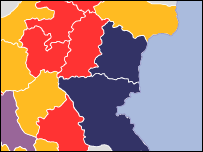
 | Map of Bulgaria showing populations of provinces 
|
According to the 2001 census, the major groups in Bulgaria's population are Bulgarians, 83.9%, Turks, 9.4% and Roma, 4.7% - but some reports say the Roma population in 2006 was more than 7%.
In 2005, about 70% of the population was urban, but the capital Sofia is by far the largest city with a population of 1.2 million.
Levels of development vary from one region to the next. The North-West region is the poorest, while the South-West region, and the area around the capital Sofia, are the wealthiest.
In early 1997, more than a third of the population was living in poverty. By 2003, the figure had shrunk to 13%. Poverty is most widespread in rural and northern areas. Human rights organisations have criticised the lack of support for homeless people, and particularly children and minorities such as the Roma.
The European Commission highlighted some key areas of concern in its report ahead of Bulgaria's accession on 1 January 2007.
It said there had been limited progress in providing care for disabled and mentally ill people, but some progress with regard to the integration of Roma.
The commission also said Bulgaria had improved measures to protect children and prevent people-trafficking.
ECONOMY
In 2005, Bulgaria's GDP was 19.5bn euros or 2,643 euros per capita (�13bn or �1,774 per capita), an increase of 5.5% compared with 2004.
Annual real GDP growth was a thumping 5.8% in 2006. Important market reforms were carried out by Bulgaria's former king, Simeon II, when he was prime minister between 2001 and 2005. Unemployment fell from highs of nearly 20% and inflation come under control, but incomes and living standards remained low.
In 2006, the unofficial grey economy accounted for up to 30% of GDP.
Bulgarian collective farms once exported vegetables and fruit to most of the Eastern bloc. But when the Soviet Union collapsed, the market for Bulgaria's produce went with it. Agricultural and industrial productivity dropped sharply and the country suffered a major national economic crisis in the late 1990s.
Production of apples and grapes, Bulgaria's main fruit products, has decreased since the communist era, but there has been a significant increase in the export of wine. Tomatoes, cucumbers, and peppers are the most important vegetable exports.
Telecommunications is one of the country's fastest growing industries. Reports say every town and many villages have a fast internet connection.
MIGRATION
Bulgarians can no longer depend on the state for employment and some villages are emptying as people leave in search of work.
Migrant Watch UK says unemployment and low incomes are the major reason for labour migration from former Eastern Bloc countries. In Poland, unemployment is about 17.7% and annual GDP per head is around 9,613 euros (�6,454) compared to 5.1% and 23,391 euros (�15,704) in the UK. In Bulgaria, unemployment is about 9.9% and annual incomes are about 6,814 euros (�4,574).
As Bulgarians look for work in wealthier European countries, there is also an opposite tendency for investors from Western Europe to buy property at low prices in Bulgaria.
| Top 10 destinations for Bulgarians travelling abroad |
| January - September 2006 |
| Country | Total | (Tourism) | (Work) | % 2005 |
| All countries | 3,140,003 | 783,489 | 1,678,192 | 97.6% |
| Turkey | 924,293 | 113,132 | 652,851 | 74.4% |
| Greece | 533,421 | 110,522 | 331,953 | 114.1% |
| Serbia & Montenegro | 352,737 | 194,269 | 133,689 | 114.1% |
| FYR Macedonia | 190,249 | 41,193 | 66,887 | 108.8% |
| Germany | 184 ,218 | 48,528 | 90,259 | 99.% |
| Romania | 164,794 | 50,210 | 99,675 | 116.% |
| Italy | 138,651 | 66,033 | 47,864 | 119.2% |
| Spain | 119,484 | 44,280 | 26,692 | 133.5% |
| Austria | 68,853 | 29,091 | 30,765 | 99.6% |
| United Kingdom | 62,408 | 2,152 | 20,252 | 122.7% |
| Source: National Statistics Institute |
ENVIRONMENT
In the early 1990s, it was estimated that 60% of agricultural land was polluted by fertilisers and pesticides, two-thirds of rivers were polluted, and two-thirds of primary forests had been levelled.
 Visitors can now go and see the closed reactors at Kozloduy |
Observers say environmental awareness has improved since the communist era, but the state's lack of administrative power, and fears of unemployment, allowed bad practices to continue. The four reactors of Bulgaria's only nuclear power station, at Kozloduy, were declared unsafe in the early 1990s, but the first of its reactors was only closed in 2002.
The plant, which supplied more than 40% of Bulgaria's electric power in 2005 is expected to cease all exports in 2007. Two of its remaining four reactors must be closed by 2007 to comply with EU standards.
Construction of the delayed Belene nuclear plant resumed in 2006 but will not be completed until at least 2011.


 One-Minute World News
  News services
 E-mail this to a friend
  Printable version

 Enlarge Map


