|
 |
 | | | | | | ||||||||||||||||||||||||||||||||||||||||||||||||||||||||||||||||||||||||||||||||||||||||||||||||||||||||||||||||||||||||||||||||||||||||||||||||||||||||||||||
| | | You are in: Europe | ||||||||||||||||||||||||||||||||||||||||||||||||||||||||||||||||||||||||||||||||||||||||||||||||||||||||||||||||||||||||||||||||||||||||||||||||||||||||||||||||
|
| | Saturday, 7 December, 2002, 00:34 GMT Accord agreed on Yugoslavia's future 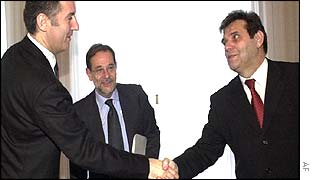 The historic agreement was signed in March 2002 Serbia and Montenegro have agreed the constitutional blueprint of a looser union that will consign the name Yugoslavia to history. The deal - after months of bickering and intense international pressure - must now be ratified by the parliaments of the two republics.
Under the accord the two republics constituting the Union of Serbia and Montenegro - as the new arrangement will be known - will share a common foreign and defence policy, but otherwise lead independent lives. The union also includes Kosovo, the largely Albanian-inhabited province which has been under international administration since 1999, when Nato forces drove out Yugoslav troops. Breakthrough Emerging from the final session of talks in Belgrade, Mr Jocic announced: "Today we have adopted the constitutional charter of the union of Serbia and Montenegro." "As one diplomat has said - Europe knows today where its borders are," Reuters news agency quoted him as telling reporters. The last obstacle - on how to elect representatives to the federal parliament - was removed after Montenegro agreed to allow for federal MPs to be elected directly after an initial period of secondment. Until then, both entities will continue to nominate the same number of members to the assembly regardless of their size - Serbia has a population of about 10 million whilst Montenegro has about 650,000 inhabitants, many ethnic Serbs. After a period of three years, the member-states have the right to initiate a procedure to change the statehood status or to leave the union of states. Euro stakes Talks to finalise the agreement had failed continually since a framework deal was first signed in March this year. Spearheading international pressure, the European Union's foreign policy representative, Javier Solana, had warned that lack of agreement meant that crucial talks on Yugoslavia's progress toward closer ties with the EU would be held back. The Kingdom of Serbs, Croats and Slovenes created in 1920 became known as Yugoslavia in 1929. After World War II, Yugoslavia became a federal socialist republic under Marshall Tito with six constituent republics - Croatia, Montenegro, Serbia, Slovenia, Bosnia-Herzegovina, and Macedonia. The Communist-era line-up disintegrated in the early 1990s as first Slovenia and then Croatia declared their independence - sparking a series of wars that saw Bosnia and Macedonia secede and the country reduced to a two-member federation constituting Serbia and Montenegro. | | See also:  06 Sep 02 | Europe 31 May 02 | Europe 15 Mar 02 | Media reports 14 Mar 02 | Europe 15 Mar 02 | Europe 14 Mar 02 | Europe 28 Dec 00 | Europe 15 Mar 02 | Europe Internet links: The BBC is not responsible for the content of external internet sites Top Europe stories now: Links to more Europe stories are at the foot of the page. | ||||||||||||||||||||||||||||||||||||||||||||||||||||||||||||||||||||||||||||||||||||||||||||||||||||||||||||||||||||||||||||||||||||||||||||||||||||||||||||||
| |
|  E-mail this story to a friend E-mail this story to a friend |
| |
| Links to more Europe stories |
| | | ||
 | ||||
 | | Back to top
| ||
| ---------------------------------------------------------------------------------- To BBC Sport>> | To BBC Weather>> | To BBC World Service>> ---------------------------------------------------------------------------------- © MMIII | News Sources | Privacy |