|
 |
 | | | | | | |||||||||||||||||||||||||||||||||||||||||||||||||||||||||||||||||||||||||||||||||||||||||||||||||||||||||||||||||||||||||||||||||||||||||||||||||||||||||||||||||||||||||||
| | | You are in: Europe | |||||||||||||||||||||||||||||||||||||||||||||||||||||||||||||||||||||||||||||||||||||||||||||||||||||||||||||||||||||||||||||||||||||||||||||||||||||||||||||||||||||||||||||
|
| | Friday, 9 August, 2002, 14:35 GMT 15:35 UK Serbia's Machiavellian politics 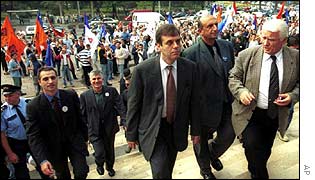 There is a power struggle at the heart of Balkan politics
 Mr Djindjic sees himself as a radical reformer struggling to overcome the legacy of decades of authoritarian rule. He and his Democratic Party want to turn Serbia into a market economy based on privatisation and integration into the international community.
Well over a year and a half since he took office, people in Serbia can see little improvement in their daily lives, says Daniel Sunter, Belgrade editor for the Institute for War and Peace Reporting. "Although every day we have news that the international community is having positive thoughts about the actions of the Serbian Government and Prime Minister Djindjic, regular people want something more to feel some benefit," he says. "Serbia is coming back into the international community. They joined the United Nations, the World Bank, the IMF, but still regular Serbs don't feel any kind of benefit from this." Expulsion moves For the past few months, Mr Djindjic has only had a tiny majority in parliament - ever since the party of Mr Kostunica left his governing coalition. To bolster his position, Mr Djindjic's coalition has twice tried to expel them from their seats in parliament - moves they have called illegal.
Marko Blagojevic is a Board Member of the Centre for Free Elections and Democracy. "The... presidency has not followed the letter of the law during the procedure in the first case," he says. "In the second case, it is not clear whether they have followed the letter of the law or not because the law does not regulate this kind of situation, in which an entire party loses the membership in the coalition that has run for elections." This is not the first time that Mr Djindjic has run close to the limits of the law. A year ago, he authorised the transfer of Yugoslavia's ex-President Slobodan Milosevic to the war crimes tribunal in The Hague by decree - in the face of opposition from the country's Federal Constitutional Court.
Speaking at the time, he said would ignore the court because its judges were Milosevic supporters who were preventing Serbia from receiving international aid. "There were reasons which motivated the government to pass such a decision. The same people who had annulled the September presidential elections today passed a similar decision bringing our country to the edge of precipice," he said. On a visit to London earlier this year, he gave a more candid justification - comparing his situation to the Germans facing Nazi-era legislation and implying that he felt under no obligation to obey what he called "bad laws". More recently, he has been accused of using the security services to monitor President Kostunica's communications and undermine the federal president's work. But Stojan Cerovic, a columnist on the weekly magazine Vreme, thinks the charges are exaggerated. "I don't think that there is any solid proof for that. The responsibility is more on the side of Kostunica's people," he said. Tough tactics Mr Djindjic's determination to push through his reform programme has led him to work with some less-than-wholesome individuals. In particular, he has protected an indicted war crimes suspect, Serbian Republic President Milan Milutinovic, in return for his political support. Sometimes however, Mr Djindjic's actions seem purely intended to undermine his opponents.
For many months, he defended the former head of the armed forces, General Nebojsa Pavkovic, against demands for his resignation. General Pavkovic had been a key ally of ex-President Milosevic and Nato had demanded his removal from power. But according to Mr Sunter, Mr Djindjic cultivated him in order to limit Mr Kostunica's control over the military. "It seems to me that... it is more important to gain victories in clashes with his rival than to continue and to stay on the line of their policy strategy of his party," says Mr Sunter. Means to an end Politics in Yugoslavia remains a rough business and to survive at the head of a coalition of 17 organisations, Mr Djindjic has had to be prepared to be just as rough. Outside the country, he has been seen as a modernising, liberal democrat. Inside Yugoslavia though, the image is slightly different, says Mr Blagojevic. "I wouldn't say exactly Western, perhaps a liberal democratic way of behaviour in terms of the way that Serbia is," he says. "In this process of transition, after decades of authoritarianism, they are more likely to follow the Machiavellian philosophy, according to which the cause justifies the means." But despite all this, Mr Djindjic retains the support of reformers because they agree with his policies and, just as importantly, he is actually getting something done. "I've known him a long time. He's not a guy who I really personally trust, but I think he's probably the best guy for the job in this country," says Mr Cerovic. "He is extremely hard working, he's a good organiser and there are not many people like that in this country. "I think he's handling his government extremely successfully considering it's a bunch of people from very different parties, very ambitious and pulling in all different directions. "Djindjic is somehow able to organise all of them and push them in more or less the same direction. "So having in mind the situation after Milosevic, I think that Djindjic really did accomplish something in terms of restoring some kind of order and recreating state institutions." Tarnished image But for all that, Mr Djindjic is unlikely ever to be a genuinely popular figure at home, regardless of how well regarded he is abroad. He lacks the charisma of his rivals and is still tarred with Milosevic-era allegations that he worked against the interests of the country when it was under attack. It is not enough for him to see his policies turned into law, he wants to see his opponents soundly defeated and politically marginalised. It is a tough strategy which wins him few friends. But his supporters believe it is the only way that Serbia can be run. | | See also:  18 Jul 02 | Europe 12 Jun 02 | Europe 25 May 02 | Europe 31 May 02 | Europe 02 Apr 02 | Europe 25 Mar 02 | Europe 19 Feb 02 | Europe 11 Jan 00 | Europe Internet links: The BBC is not responsible for the content of external internet sites Top Europe stories now: Links to more Europe stories are at the foot of the page. | |||||||||||||||||||||||||||||||||||||||||||||||||||||||||||||||||||||||||||||||||||||||||||||||||||||||||||||||||||||||||||||||||||||||||||||||||||||||||||||||||||||||||||
| |
|  E-mail this story to a friend E-mail this story to a friend |
| |
| Links to more Europe stories |
| | | ||
 | ||||
 | | Back to top
| ||
| ---------------------------------------------------------------------------------- To BBC Sport>> | To BBC Weather>> | To BBC World Service>> ---------------------------------------------------------------------------------- © MMIII | News Sources | Privacy |