Officials hope loan guarantees would prevent the Greek crisis spreading
EU finance ministers are meeting in Brussels to discuss establishing a new "stabilisation mechanism" to prevent the Greek debt crisis from spreading.
They discussed extending some emergency funding, currently only available to non-eurozone members, to the single currency bloc.
They are also believed to have looked at a system of loan guarantees, potentially worth billions of euros.
The meeting has continued late into the evening, without any press conferences.
Exact details of what was on the table are not yet known.
While bail-outs are technically banned under EU rules, the European Commission reportedly plans to extend an existing clause in the Lisbon Treaty, originally designed to allow it to provide aid to non-eurozone states experiencing serious difficulties, to eurozone members.
Mr Darling says the UK will not provide support for the euro
A news conference had been scheduled for late on Sunday afternoon but was postponed after the German Finance Minister Wolfgang Schaeuble was rushed to hospital.
His ministry said he had an allergic reaction to some medication. Interior Minister Thomas de Maiziere travelled at short notice to Brussels to lead the German delegation instead.
'Right safeguards'
Speaking ahead of the meeting of finance ministers, UK Chancellor Alistair Darling said it was important to do "what is necessary" to ensure stability, but the UK would not provide support for the euro.
"So far as Europe is concerned there is a separate proposal to make available help to eurogroup members as they do to non-eurogroup members like Hungary and Romania. Subject to the right safeguards, and IMF involvement we could support that," he told the BBC.
"But what we won't do is provide support for the euro - that has to come from those countries that use the euro."
If the finance ministers were to announce only the 50bn euro fund, investors would see that as wholly inadequate insurance against a possible collapse of lending to financially stretched European countries
The Commission is seeking approval for an ambitious mechanism that could be used to fund hundreds of billions of dollars of loans.
The BBC's Jonny Dymond in Brussels says officials at the European Commission have laboured throughout the weekend to rush through these plans.
Under the proposals, the Commission would borrow money for the stabilisation mechanism directly on the markets to guarantee troubled country's debts.
Officials hope the loan guarantees would prevent the crisis in Greece spreading to other eurozone countries with high deficits or debts as well as low economic growth, most notably Portugal, Spain and Ireland.
"Between now and Sunday night we will have a watertight line of defence," Eurogroup Chairman Jean-Claude Juncker said on Saturday.
"We have to make it clear that all eurozone countries are ready to defend each and every eurozone country, because they want to defend the eurozone as a whole," he added.
What went wrong in Greece?
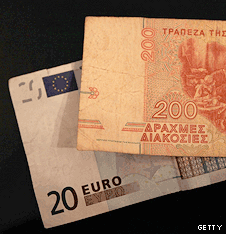
Greece's economic reforms that led to it abandoning the drachma as its currency in favour of the euro in 2002 made it easier for the country to borrow money.
Greece went on a debt-funded spending spree, including high-profile projects such as the 2004 Athens Olympics, which went well over budget.
It was hit by the downturn, which meant it had to spend more on benefits and received less in taxes. There were also doubts about the accuracy of its economic statistics.
Greece's economic problems meant lenders started charging higher interest rates to lend it money and widespread tax evasion also hit the government's coffers.
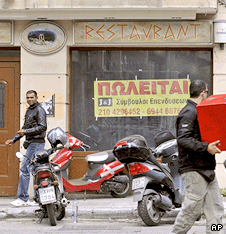
There have been demonstrations against the government's austerity measures to deal with its 300bn euro (�267bn) debt, such as cuts to public sector pay.
Now the government is having to access a 110bn euro (�95bn; $146.2bn) bail-out package from the European Union and International Monetary Fund.
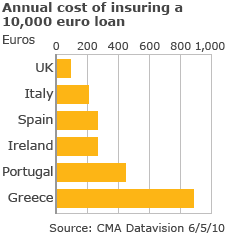
Greece's problems have made investors nervous, which has made it more expensive for other European countries such as Portugal to borrow money.
BACK{current} of {total}NEXT
Our correspondent says political acceptance from EU nations is critical.
The UK may be happy with the emergency package, but it is not prepared to be part of any EU-style IMF guaranteeing loans.
Market fears
Deciding the contribution of each country to the stabilisation mechanism could also be a stumbling block.
Fears that a debt default by Greece could paralyse the world's financial system - just as the collapse of Lehman Brothers did two years ago - caused European, US and Asian stock markets to plunge in the past week.
On Friday, the leaders of the 16 countries that use the single currency approved an 110bn euro ($145bn; £95bn) loan package to Greece, which is backed by the EU and IMF. Sunday saw the IMF's board approve its 30bn euro tranche of this loan.
The 16 leaders also agreed to take whatever steps were needed to protect the euro, and to accelerate budget cuts and ensure deficits were addressed.
Also on Friday, bankers urged the European Central Bank to become the "buyer of last resort" of eurozone government bonds to steady markets.
President Obama wants a stable European economy
The president of the European Central Bank, Jean-Claude Trichet, said it had not yet discussed the move but was willing to respond to unfolding events.
The Italian Prime Minister, Silvio Berlusconi, and French President Nicolas Sarkozy have cancelled foreign trips because of the severity of the crisis.
In an interview with Russian media on Saturday, US President Barack Obama said: "I am very concerned about what's happening in Europe. But I think it is an issue that the Europeans recognise is very serious."
 One-Minute World News


 E-mail this to a friend
  Printable version


 If the finance ministers were to announce only the 50bn euro fund, investors would see that as wholly inadequate insurance against a possible collapse of lending to financially stretched European countries





 BBC News


Bookmark with:
What are these?