Chancellor Alistair Darling second Budget has announced the largest budget deficit since World War II.
The projected budget deficit of 12% of GDP in 2010 is bigger as a proportion of GDP than in any other major economy - compared with 8.9% in the US, 6.2% in France and 3.2% in China. Total government debt will double in the next few years, and independent experts say it is unlikely to return to previous levels for a generation.
The prospects for the UK economy have dramatically worsened since the last Budget. One year ago Mr Darling thought the economy would grow by 2.5% this year; now he says it will shrink by 3.5%. But he is still hoping it will bounce back next year.
 | UK CLAIMANT COUNT 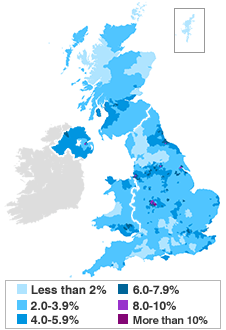 To view the enhanced content on this page you need to have Javascript enabled and Flash player 9 installed. % of population claiming Jobseeker's Allowance, by parliamentary constituency. Source: ONS |
As well as swelling the budget deficit, the recession is also leading to rising unemployment. By the government's preferred measure, unemployment has already topped the two million level, and some suggest it will keep rising to around three million by the end of the year. Unemployment tends to continue to rise even after an economic recovery begins, and it could depress any recovery in house prices and increase the cost of benefits paid out by the government. Regionally, unemployment in concentrated in inner cities areas, especially in the Midlands and North. The claimant count - the percentage of the working population who are claiming jobseeker's allowance - has now increased for 14 months in a row. The claimant count rate in March 2009 was 4.5%, up 0.2% on the previous month and 2.1% on a year earlier.
The current budget squeeze means that the gap between government spending and taxes will continue to widen. The government may also face higher costs as benefits and debt service rise. If it also tries to protect health and education, other services could face major cutbacks. And some of the huge cost of the various bank bail-outs and guarantees may have to be paid for in the future.
|  One-Minute World News


 E-mail this to a friend
  Printable version


 BBC News


Bookmark with:
What are these?