|
 |
 | | | | | | ||||||||||||||||||||||||||||||||||||||||||||||||||||||||||||||||||||||||||||||||||||||||||||||||||||
| | | You are in: Business | ||||||||||||||||||||||||||||||||||||||||||||||||||||||||||||||||||||||||||||||||||||||||||||||||||||||
|
| | Tuesday, 29 October, 2002, 14:19 GMT Schroeder tells Germans to sacrifice 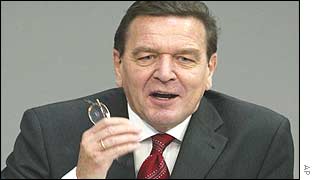 Schroeder: "We are living in difficult economic times" Germany's Chancellor Gerhard Schroeder has told the country that taxes must rise, the welfare state be cut back and the labour market be liberalised. The dire warnings came in the Chancellor's first policy speech since the re-election of his governing coalition of Social Democrats and Greens a month ago.
Once again Mr Schroeder pledged to cut unemployment - standing at 10% of the workforce or just over four million people - echoing his broken promise of four years ago, when he said he would push the queues at job centres to less than 3.5m workers. But Mr Schroeder ruled out government spending to stimulate growth. And he once again stated his opposition to a US war against Iraq, a stance that is credited with helping him to win re-election, but has soured relations with Washington. Germany "will not participate in any military strike against Iraq", he said. Tough times "People in Germany know that we are living in difficult economic times," he said before launching into a defence of his government's plans to raise taxes. Taunting the opposition, he said German voters had re-elected his government because they "expressly did not decide to scrap the welfare state, cut benefits indiscriminately and roll back employees' rights".
But that came with a warning that "some entitlements, rules and allowances of the German welfare state" would be reconsidered. The opposition immediately decried Mr Schroeder as dishonest over the tax increases and claimed the election was a fraud. "It's indecent what you're doing," said Angela Merkel, leader of the conservative opposition Christian Democrats who were beaten by Mr Schroeder by just 6,027 votes. Economic outlook Mr Schroeder said there were few signs of improvement in the global economy in the short term "The development in the international financial and stock markets, reticence by consumers and investors in all the major economies, continued uncertainty in raw materials and energy markets and the explosive situation in the Middle East provide little cause for hope of an early improvement in the world economy," he said. He reiterated that Germany was committed to balancing its budget by 2006, in line with the European Union's Stability and Growth Pact. "It must be clear that the stability pact itself is not under discussion," he said. "What we need is more flexibility to permit countermeasures in times of economic difficulty." Germany admitted this month that a stagnant economy would push its budget deficit this year above the ceiling of 3% of gross domestic product set by the pact. Germany, Europe's largest economy, is expected to grow just 0.4 this year and 1.4% next. | |
See also:  28 Oct 02 | Business 16 Oct 02 | Business 23 Sep 02 | Business Internet links: The BBC is not responsible for the content of external internet sites Top Business stories now: Links to more Business stories are at the foot of the page. | ||||||||||||||||||||||||||||||||||||||||||||||||||||||||||||||||||||||||||||||||||||||||||||||||||||
| |
|  E-mail this story to a friend E-mail this story to a friend |
| |
| Links to more Business stories |
| | | ||
 | ||||
 | | Back to top
| ||
| ---------------------------------------------------------------------------------- To BBC Sport>> | To BBC Weather>> | To BBC World Service>> ---------------------------------------------------------------------------------- © MMIII | News Sources | Privacy  |