
|
 |
 | | | | | | |||||||||||||||||||||||||||||||||||||||||||||||||||||||||||||||||||||||||||||||||||||||||||||||||||||||||||||||||||||||||||||||||||||||||||||||||||||||||||||
| | | You are in: Business | |||||||||||||||||||||||||||||||||||||||||||||||||||||||||||||||||||||||||||||||||||||||||||||||||||||||||||||||||||||||||||||||||||||||||||||||||||||||||||||||
|
| | Thursday, 17 October, 2002, 11:52 GMT 12:52 UK Cocoa farmers hope for peace 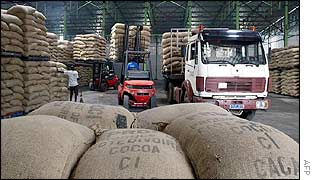 The cocoa trade is vital to the Ivory Coast economy
Since trouble broke out in Ivory Coast on September 19, exporters and traders have been remarkably sanguine. When the cocoa season began on 1 October, they were still cautiously optimistic, since the initial conflict was mostly confined to the northern half of the country, and had not yet reached the main cocoa-growing region. But when trouble hit Daloa, a key central town on the edge of the south-western cocoa belt, alarm bells began to ring. Now there is new hope for the farmers with representatives of both sides in the conflict expected to meet with West African mediators on Thursday to sign a ceasefire agreement. Nervous The small town of Bonon lies on the edge of a main through-road from Daloa to Yamoussoukro.
It is in a lush forested zone, typical of much of Ivory Coast's cocoa belt. The town itself is not much more than a cluster of market stalls and a couple of warehouses run by the local cocoa co-operative. Residents here are understandably nervous. As night begins to fall, a farmer anxiously glances over his shoulder and directs me down a rough track into a dimly lit compound. You can not be too careful, he says. You do not know who might be coming along the road, rebels or government forces in search of a good vehicle. 'Scandal' Only once we had found a discreet location at a quiet backstreet bar, with a bottle of beer to ease the tension, do the cocoa farmers voice their concerns. The regional delegate for the National Coffee and Cocoa Producers' Association says this conflict could not have happened at a worse time. "It's such a scandal and the greatest losers are the coffee and cocoa producers," he says. "It's a level never seen before in Ivory Coast. Even in the days of the Ivorian miracle we'd never achieved such a price. "The economy of the country will be forced to its knees if we cannot find a peaceful solution." Fleeing workers At the other end of the scale many of the vital workers that pick the pods have already begun to flee the fields.
A large proportion of the labour force are made up of West African immigrants, the majority from Burkina Faso. Many of them have been targeted or attacked by local youths or security forces because their country is being blamed for backing the current insurgency. One thing everyone agrees on is that peace is an essential prerequisite for prosperity the cocoa industry, as the president of the local co-operative explains. "It's a chain. The labourers work in the fields, the coffee or cocoa is ready, and they are paid out of the money gained from sales. "But if there are no buyers and no money, it's no good. "That's why everyone wants peace, for security of the product, for everyone to be paid and no problems, so the product can be sold and everyone is satisfied." 'Lungs of the economy' Others wonder whether it is in the interests of the rebels to block the production of Ivory Coast's main money earner. One farmer just hopes the rebels will leave him alone. "What I'm worried about is that if the rebels arrive in a zone, will they let us work," he says. "We are peasants. We don't have any financial resources. Our only means of finance is cocoa and coffee. "So my wish is that if those people arrive, they just let us work normally so that we can carry on working peacefully with our labourers, our families and our children." With just a couple of weeks left before the busiest harvest time, from November to December, farmers are praying for a rapid resolution to the crisis before it is too late. To coin a local phrase, cocoa and coffee are the lungs of the economy, and they want to see it breathing again. | |
See also:  16 Oct 02 | Africa 16 Oct 02 | Africa 16 Oct 02 | Business 15 Oct 02 | Africa 10 Oct 02 | Business Internet links: The BBC is not responsible for the content of external internet sites Top Business stories now: Links to more Business stories are at the foot of the page. | |||||||||||||||||||||||||||||||||||||||||||||||||||||||||||||||||||||||||||||||||||||||||||||||||||||||||||||||||||||||||||||||||||||||||||||||||||||||||||||
| |
|  E-mail this story to a friend E-mail this story to a friend |
| |
| Links to more Business stories |
| | | ||
 | ||||
 | | Back to top
| ||
| ---------------------------------------------------------------------------------- To BBC Sport>> | To BBC Weather>> | To BBC World Service>> ---------------------------------------------------------------------------------- © MMIII | News Sources | Privacy |






