|
 |
 | | | | | | |||||||||||||||||||||||||||||||||||||||||||||||||||||||||||||||||||||||||||||||||||||||||||||||||||||||||||||||||||||||||||||||||||||||||||||||||||||||||||||||||||||||||
| | | You are in: Business | |||||||||||||||||||||||||||||||||||||||||||||||||||||||||||||||||||||||||||||||||||||||||||||||||||||||||||||||||||||||||||||||||||||||||||||||||||||||||||||||||||||||||||
|
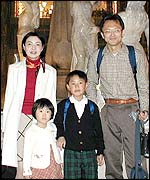
| | Wednesday, 9 October, 2002, 05:47 GMT 06:47 UK Tales from Japan's 'golden recession' 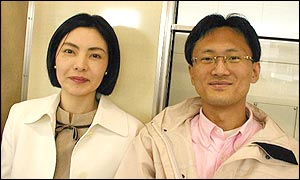 Kyoko and Akihiko worry about saving for the future
For a decade, Japan's economy has stagnated, leaving its people anxious but strangely resilient. The election of Prime Minister Junichiro Koizumi last year brought hope for many, but the new broom has so far proved a disappointment. BBC News Online interviewed a cross-section of people from Japan and discovered conflicting undercurrents of feeling. The "golden recession" has spawned needling doubts, worries about money, a yearning for change and grim anecdotes about subway suicides. Click below for the individual stories: The married couple Kyoko and Akihiko Ebashi are married with two children. Kyoko, aged 37, has worked as a teacher and part-time for an accountancy company, but now she looks after the children.
Maybe our stupid government will not be able to afford to support elderly people then. We also have to spend money on education for the children. The Japanese love to educate themselves and it costs a lot of money, even at kindergarten.
Right now the economy is going down and interest is going down also. We spend money on houses because there is no interest for savings in the bank. I also think our insurance policy is not safe now - we are wondering if we will lose a lot of money if the company collapses. There is always a rumour that some company is going to ruin. People are not depressed, but mothers are coming down hard on their children. They want them to study hard, otherwise they might not get jobs because of the economy.
But Japan doesn't like to change. They want business as usual. When I was a child it was very difficult to find a homeless person near my house. Now they are everywhere. One of the first words children learn is the Japanese word for "homeless". They are not energetic like the homeless in New York, who want money. They are just lying down and sitting still. Kyoko's husband Akihiko is a 39-year old banker.
The working situation is getting tougher than before - people are worried. Companies have been recruiting less graduates than before and making retirement mandatory.
The current economic problems are very serious. There must be some solution but many people are struggling to solve the problems, including politicians, economists and leaders of companies. There's some feeling that the economy is maybe changing in some way because Mr Koizumi has been trying to do many things. We do not see good results at the moment, but he's trying very hard. The student Kiichiro Kanai is a 24-year old student, who is currently living in the Netherlands. He is studying for a diploma in accountancy and international business.
No money for travelling to Hawaii? No money to buy gadgets? No money to go to Karaoke? If you go to Japan, it doesn't look different at all, it still looks super-modern.
Yes, it might be difficult to get jobs at very prominent companies, but there are still so many small and medium-sized companies to work for. My father lost his holiday company because he had a lot of loans and the government wanted to improve the banking situation. But now he is running another business, selling golf memberships. There are many depressed people in clinics everywhere. In Tokyo I used to take the subway to college, and you could hear people killing themselves once in a while. It was absolutely related to the economic problems. You have to understand the culture: the Japanese are perfectionist people. They feel pressure and if they can't get it perfect, they commit suicide. Many middle-aged men get sacked and have nowhere to go. They never anticipated it and because of pride, they commit suicide. The sales manager Aki Harada works for a relocation company, catering to ex-pats in Tokyo. He is 34 this month, and is married with no children.
Clients are also trying to get cheaper prices. Many of our clients are banks and because their business is bad, it affects us.
We have just bought a house in Tokyo - it was a good chance to get tax back from the government. Before I worked for a bread-making company. I quit my job to learn English, but now people would think twice about doing that. One of my friends didn't have a job for one and a half years. I don't know if he was depressed - I didn't ask - that would be too personal. I support the prime minister and I vote for him. The foreigner Steve Koya, aged 33, is British but married to a Japanese woman. He works in Hokkaido as computer systems manager for a concrete producer.
But Japanese people have a certain way of doing things. My business partner was not prepared to take any risks, he just wanted to pay the wages every month.
There have been problems in my current company, with moving forward. The vice president is very, very different from the typical Japanese - he spent four years working in New York. But the company directors are old guys who have been there for years. They are happy to spend money on expensive equipment, but not on software or computer systems to streamline the company. This year particularly has seen a huge slump in government-funded construction projects, or rather the extension of them. Around us every day, other less fortunate concrete companies go bankrupt.
The Japanese have so much money saved up, that it hasn't affected them at all. It's like a perpetual safety blanket. Until it starts hurting, they are not going to do much about it. The housewife Noriko Kimura used to temp in Tokyo, but now stays at home to look after her baby. She is married to Donald, who works in computers.
I get really worried about Donald losing his job. He is earning enough money, but he is getting older.
There is more temping now as it is difficult to find permanent jobs. Before when I was looking for a job, everyone would ask if I was going to have a baby because I was a woman. We are careful about spending and we don't eat out so much these days. We bought an apartment this year so it is difficult to save. Donald has a bank account in euros because it is safer than yen and there is more interest. The working woman Yuko Furuya, aged 42 and unmarried, has worked for seven years at Fujitsu-Siemens.
I worry about the future when I get old. I worry if I get sick and I don't have enough pension. The government is trying to do something, but I don't think it is doing well.
In the 1980s there was more business and therefore people worked more and spent more. Now the bubble has broken. There is not enough business and therefore many people have been fired or they are getting less salary. There is also a contrast between people on the poor side and some people who are getting lots of money. The academic Robert Ridge, aged 51, is a professor at the International Christian University in Tokyo. He grew up in the UK, but finished his education in Australia. He is married to a Japanese woman and has three children.
Strangely, however, banks will simply not lend money to foreigners. When I applied for a car loan at my local bank, I was refused.
Some call it the "golden recession" here because it hasn't had any visible impact on Japan. But gradually it is getting worse and worse. Students are having problems getting jobs and people are getting laid off.
People don't spend as much anymore. My wife says the 50 yen shop is now popular (it used to be a 100 yen shop). We haven't decided whether to retire in Japan - it depends on the value of the yen. The Japanese people are patient in all facets of life. Things go on and on for years and then suddenly masses of changes happen. But I'm not holding my breath. My wife says Mr Koizumi is a big wimp. Although he was initially seen as independent, he's still terribly weak-kneed and he's not making any progress. The consultant Kazuhiko Yamashita, aged 43 and unmarried, is a part-time consultant for the construction industry.
I agree with him, but I feel reformation is still so difficult. I believe there should be more independence for local government, less bureaucracy and increasing mobility of labour. We are suffering from deflation - the prices of goods are decreasing a lot.
My brothers and I support my father financially. My parents - 70 and 76 - are optimistic because they don't think they will live long. But they worry about our lives and their grandsons. Now that I am 43 years old, I worry about my pension plan and my money when I am retired. There is a very low birth rate in my society and we often talk about that issue. Maybe we Japanese have to accept immigrants from abroad, like the UK does. I like Mr Koizumi, but the other people who surround him in the Liberal Democratic Party are too conservative. It is a very old-fashioned and out-of-date party. We would welcome someone like Margaret Thatcher - she's a very aggressive, iron lady. We need that kind of person in Japan, we need a strong leader. | |
See also:  27 Sep 02 | Business 20 Jun 02 | Business 22 May 02 | Business 02 May 02 | Business Internet links: The BBC is not responsible for the content of external internet sites Top Business stories now: Links to more Business stories are at the foot of the page. | |||||||||||||||||||||||||||||||||||||||||||||||||||||||||||||||||||||||||||||||||||||||||||||||||||||||||||||||||||||||||||||||||||||||||||||||||||||||||||||||||||||||||
| |
|  E-mail this story to a friend E-mail this story to a friend |
| |
| Links to more Business stories |
| | | ||
 | ||||
 | | Back to top
| ||
| ---------------------------------------------------------------------------------- To BBC Sport>> | To BBC Weather>> | To BBC World Service>> ---------------------------------------------------------------------------------- © MMIII | News Sources | Privacy |






 We are saving money for when my husband retires and because the economy is getting worse.