By Michael Bristow
BBC News |
 It was one of the first Chinese ports used by European traders, whose influence can still be seen in the city's architecture.  The city is one of China's richest |
But it is Xiamen's position opposite Taiwan - an island that China considers its own - that has had the biggest effect on its modern history. Taiwanese companies have invested millions of dollars in Xiamen and the surrounding area over the last couple of decades. And the city is expecting more to make their way across the Taiwan Strait when the island's new president, Ma Ying-jeou, takes office on 20 May. Mr Ma has promised to establish regular direct flights between Taiwan and the mainland for the first time since the two sides split in 1949. Courting Taiwan Xiamen's local government is just one organisation that thinks this will improve the fortunes of a city that is already one of China's richest. "In the long term, Xiamen's port business will naturally become increasingly optimistic," it says on the city government website.  | CHINA RELAY CITIES IN FOCUS Use the map to see the full Olympic torch relay route or read about some of the key cities:
Full route map, Hong Kong, Guangzhou, Xiamen, Jinggangshan, Shanghai, Nanjing, Huangshan, Three Gorges, Kaili, Lhasa, Urumqi, Xian, Yanji, Weihai, Qufu, Anyang, Beijing. |
Others are also upbeat about the prospect of closer ties - referred to as the "three links" of post, transport and trade. Chinese local media report that Xiamen has begun a three-stage project to expand the city's airport in preparation. And the chairman of Xiamen's Taiwanese business association, Zeng Qingzhao, says direct flights will undoubtedly attract more Taiwanese firms. "They have already started coming, and they are relatively large companies, including listed firms," he said. One of those large Taiwanese companies is AUO, which opened a factory making TV and computer panels in Xiamen last year. Artillery fire There are already limited links between Taiwan and China, contact known as the "three mini-links". Set up in 2001, these sea routes operate between Taiwan's outlying islands of Kinmen and Matsu, and several Chinese ports, including Xiamen. According to the Taiwanese government, nearly two million passengers and trade worth more than $40m (�20m) had used these routes by the end of 2006.  Close links have been forged with Taiwanese companies |
But Taiwanese businessmen regularly complain that the lack of direct flights hampers their work on the Chinese mainland. If they want to fly to China, Taiwanese citizens currently have to go via a third place, usually Hong Kong, Macau or Japan. Of course, direct flights will not just help the two sides' economies, it will also reduce political tension. China and Taiwan have been at loggerheads since the civil war ended and the defeated Chinese Nationalist Party fled to Taiwan. Taiwan's ultimate status, as a part of China or as an independent country, has still not been resolved. Xiamen has been on the front line in this battle. The two sides once regularly exchanged artillery fire across the narrow stretch of water between Xiamen and Kinmen, spelt Jinmen on the mainland. Today, mainland tourists join cruise ships that sail right up to Kinmen to get a better view of the enemy. If Mr Ma has his way, the future will bring even more contact between people from China and Taiwan - and Xiamen is in the right place to benefit.
|  One-Minute World News


 E-mail this to a friend
  Printable version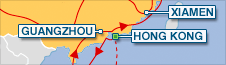


 BBC News


Bookmark with:
What are these?