Hong Kong spent more than 100 years as a British colony
With its skyscrapers, hills and waterfront, Hong Kong provides a fitting backdrop for the Olympic torch's return to China.
Born after a shameful episode in Britain's colonial history, Hong Kong has become one of the world's leading economic hubs.
This former British colony, handed back to China in 1997, is without doubt China's most modern, open and international city.
It is also a political oddity. Hong Kong is ultimately ruled by Beijing, but China mostly leaves the territory to govern itself, designating it a Special Administrative Region.
Under this "one country, two systems" model, Hong Kong citizens enjoy far more rights and freedoms than their mainland neighbours.
Advertisement
The BBC's Quentin Sommerville gives his view of Hong Kong
Hong Kong has a long history. For centuries, its hills and islands were occupied by Chinese farmers and fishermen.
But it was not until 1841 and the arrival of the British, looking for a permanent base in southern China, that the region's commercial development began in earnest.
China was forced to cede Hong Kong to the British after a brief one-sided war, caused in part by Britain's determination to keep selling opium in China.
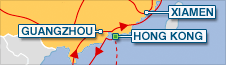
CHINA RELAY CITIES IN FOCUS
Use the map to see the full Olympic torch relay route or read about some of the key cities:
Afterwards the colony, whose name means fragrant harbour in Chinese, slowly emerged as an important trading port - a position it still maintains today.
A boat trip around Hong Kong reveals hundreds of wharves, harbours and docks, where ships unload cargo from across the world.
But a good natural harbour and prime location at the southern tip of a vast Chinese nation did not guarantee the territory success.
That came from the ingenuity and hard work of its mostly Chinese inhabitants, many of whom have made themselves rich in the process.
As Hong Kong citizens, we have very mixed feelings towards our mother country
Their wealth is everywhere to be seen; in the high-powered cars that drive the streets and the shops crammed with jewellery, clothes and electronic gadgets.
These people originally came from the mainland, mostly after political upheavals such as the fall of the Qing Dynasty in 1911 and the communist victory in 1949.
But Hong Kong is also successful for something else, something provided over decades by its British colonial rulers.
The British might have come to enrich themselves, but they also built a legal and administrative framework that allowed others to do the same.
The regional government today readily admits that the impartial rule of law and an independent judiciary are the bedrock on which Hong Kong is based.
When they were negotiating the return of Hong Kong, China's leaders promised to maintain this system for 50 years.
Hong Kong is the only place in China where torch protests are expected
There have been complaints that Beijing has gone back on this promise and is gradually eroding Hong Kong's special status.
But most people agree that China has largely left things as they were in the decade or so since Hong Kong was handed back.
And China has also promised the city's voters will be able to directly elect their chief executive in 2017, provided certain conditions are met.
Perhaps the biggest threat to Hong Kong's unique status and success will be economic rather than political.
In 1978 following years of self-imposed isolation, China began to open to the outside world and reform its command economy.
Over the last 10 years those reforms have gathered pace, with booming ports such as Shanghai looking to catch up and take over Hong Kong.
So if it is to maintain is pre-eminent position, Hong Kong will have to continue adapting.
 One-Minute World News


 E-mail this to a friend
  Printable version




 As Hong Kong citizens, we have very mixed feelings towards our mother country


 BBC News


Bookmark with:
What are these?