 Yang Liwei was greeted by locals and officials in Inner Mongolia |
China's first astronaut has landed back on Earth to a hero's welcome after an historic mission in which he orbited the globe 14 times. The Shenzhou 5 craft touched down on Thursday morning in northern China, 21 hours after being rocketed into space.
Astronaut Yang Liwei emerged from the capsule saying: "I'm feeling good. I'm proud of my motherland," before being whisked away to meet political leaders in the capital Beijing.
Chinese officials said the next goals in the country's space programme would be to set up a space laboratory and a space station.
Yang Liwei's return fulfils China's bid to become only the third country to send a man into space, after the former Soviet Union and the United States.
Click below to see the return trajectory of the Shenzhou spacecraft 
|
Prime Minister Wen Jiabao sent his congratulations and hailed the mission "a complete success" after speaking with Yang. Accolades from around the world poured in.
In the United States, Nasa administrator Sean O'Keefe described it as an important achievement.
United Nations Secretary General Kofi Annan said space exploration knew no national borders, "the mission of the Shenzhou 5 is a step forward for all mankind".
Next step
As well as planning for a future space station, Chinese officials also hoped to launch Shenzhou 6 before the end of 2005, said Xie Mingbao, director of the manned space office.
"The development of manned space technology has great significance of improving China's overall national strength and its international influence [and] boosting the sense of national pride," said the manned space engineering office in a statement. The BBC's Louisa Lim in Beijing says the country's leaders will be hoping this first successful manned flight will promote patriotism and rally the nation.
Yang Liwei, the 38-year-old fighter pilot in the People's Liberation Army, had left Earth a virtual unknown.
Emerging from the capsule to cheers from more than 600 locals, his name is now on the lips of the world.
Emergence
BBC correspondents found Beijingers from all walks of life hailing the mission as a sign of China's emergence as a force to be reckoned with on the world stage.
"China has always been the superpower, and now, with a big step forward, we can hear the sound: we are back!" one man told BBC News Online.
 | CHINA'S SPACEMEN Yuhangyuan - Chinese for space navigator Used in official media Taikonaut - derived from taikong, space Coined by Singapore-based website |
"Now [the world] will realise that we don't only make clothes and shoes," said another. The same feelings of triumph could be found on popular internet sites such as Sina.com.
"Today is your holiday, my motherland," wrote one anonymous commentator.
But there were also those who were less impressed.
"What are you so foolishly happy about?" asked one.
"Go to the countryside and see how many people there care about this. Ask them what's more important, earning a yuan or sending up a spacecraft?"
And then there were those who missed out on the whole thing.
"Shenzhou what? Never heard of it," said an 18-year-old potato vendor in the northern province of Hebei.


 One-Minute World News
  News services
 E-mail this to a friend
  Printable version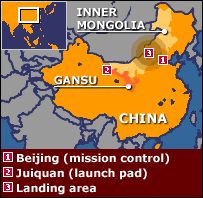
 Enlarge Map
 We're still developing but look at the speed!


 Reaction from streets
