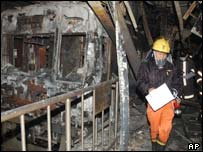
 Why did so many people die? |
Preliminary investigations into Tuesday's train fire in Daegu, South Korea, indicate that human error is likely to have contributed to the high death toll. At least 125 people died when a suicidal man poured a canister of petrol into a train carriage and then ignited it.
The train was engulfed in flames within minutes, and the inferno quickly spread across the platform to a second train, which had pulled into the station minutes after the first train caught fire.
South Korean President-elect Roh Moo-hyun promised on Thursday to "thoroughly investigate the cause of the accident and why the damage has been huge".
"We will take every means possible to ensure that this tragedy will not happen again," he said.
'They won't open the doors'
One of the major questions being asked is why the train doors were left shut, even when the fire had begun to spread.
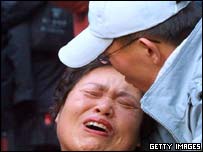 Relatives are demanding answers |
Rescuers said the doors of the second train - in which most people died - remained locked for 20 minutes after the fire had started. In a mobile phone conversation published in the South Korean press, a schoolgirl said to her mother: "I'm at Joongangro station. There is a fire, but they won't open the doors."
Transcripts of a radio conversation between rail officials at the time of the disaster reveal that vital minutes were lost before the train was evacuated, according to the Associated Press.
The driver was heard to say: "It's a mess. It's stifling. Take some measures please. Should I evacuate the passengers? What should I do?", the agency reports.
There is also mounting evidence that the power supply was automatically cut off, locking the doors and plunging the station into darkness.
Communication breakdown
Critics also question why the second train was in the station at all.
The radio transcripts suggest that the operators knew the first train was on fire when they allowed the second one to pull into the station, according to AP.
The driver was told: "When you enter the Joongang Station, drive carefully. There is a fire," the news agency reported.
Questions are also being raised about the speed at which the trains caught fire.
No fireproof material was reportedly used in the trains' manufacture, and some of the components - including flammable plastics - were known to emit toxic fumes when burned.
Most victims died from smoke inhalation, according to rescue services.
Another factor which has been raised to account for the scale of the tragedy is the absence of a sprinkler system.


 One-Minute World News
  News services
 Email this to a friend
  Printable version
