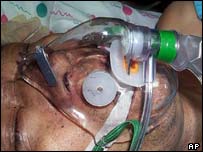
 Kim was arrested in hospital |
Police in the South Korean city of Daegu have said the man who started the underground fire which killed 124 people on Tuesday had a history of mental illness. Kim Dae-hwan, a 56-year-old local man, admitted to starting the fire with the intention of committing suicide, police said.
But other details of his life are still patchy.
A former taxi or truck driver, Mr Kim is said to have lost his job last year after suffering a stroke which left him partially paralysed.
South Korean television reports said he had once threatened to burn down a hospital because he felt he had received unsatisfactory treatment.
Mr Kim's 28-year-old son told police that his father had talked of suicide before, threatening to throw himself on the tracks in front of a subway train.
 He decided not to die alone and searched for a place crowded with people He decided not to die alone and searched for a place crowded with people  Police Lieutenant Cho Doo-won |
Suicide bid
"The suspect left home in the morning and stopped by a gas station and bought 7,000 won ($6) worth of gasoline," said police detective Cho Doo-won, head of the investigation team at Daegu police station.
"He said he wanted to commit suicide by self-immolation, but later he decided not to die alone and searched for a place crowded with people," Mr Cho said.
Mr Kim was arrested in a local hospital, while being treated for his injuries.
Other victims who were receiving treatment in the same hospital identified him to police, according to local media reports.
Witnesses described him as a middle-aged man wearing a blue tracksuit, who poured petrol from a plastic bottle into one of the train carriages at 10:00 am local time (0100 GMT).
"He soaked the floor of the train with the liquid and lit it with his cigarette lighter," Jun Yung-Nam, 64, told Yonhap news agency.
Some of the other passengers tried to stop him, but he fought them off and threw the bottle to the ground, witnesses said.
Within minutes a blaze swept through the entire six-carriage train, and engulfed another six-carriage train standing next to it, killing more than 100 people.


 One-Minute World News
  News services
 Email this to a friend
  Printable version
