 An area the size of Haiti has been lost to farming over 12 months |
New satellite information from Brazil has revealed a sharp increase in the rate of destruction of the Amazonian rainforest.
The information shows the speed of deforestation increased by 40% between 2001 and 2002 to reach its highest rate since 1995.
Figures from the National Institute for Space Research (INPE) show more than 25,000 square kilometres of forest were cleared in a year - mainly for farming.
AMAZON DEFORESTATION 2002: 9,840 square miles (25,476 sq km) lost 2001: 7,010 square miles (18,166 sq km) lost |
Environmentalists have expressed alarm at the development which represents a sharp reversal of a trend in which destruction had been slowing. "The rate of deforestation should be falling, instead the opposite is happening," said Mario Monzoni, a project co-ordinator for Friends of the Earth in Brazil.
Environmental organisations say one major cause is the spread of large-scale soya farming in the southern Amazon.
Facts, figures and satellite images of Brazil's shrinking rainforests 
|
Soya production is growing rapidly in the area as a crop that offers large profits for farmers and gives a sizable boost to Brazil's trade accounts. But campaigners also blame the authorities for failing to enforce environmental protection laws.
The country's centre-left government, under the leadership of President Luiz Inacio Lula da Silva, is due to announce new proposals next week to tackle deforestation.
Task ahead
The new Environment Minister, Marina da Silva, who has long campaigned to protect the Amazon, has promised to action but she inherits a difficult situation, says the BBC's Sao Paulo correspondent Tom Gibb.
On the one hand, the country has a new multi-million dollar satellite and radar monitoring system providing plenty of accurate data as to where deforestation is occurring.
But budget cuts on the ground mean that environmental protection agents often do not even have enough money to buy petrol for their boats and cars, let alone mount operations to arrest illegal loggers and farmers, our correspondent says.
Likewise, loopholes and corruption in Brazil's chaotic judicial system mean those caught destroying the forest almost always go unpunished.
The Amazon is the largest rainforest in the world and is home to 30% of all animal and plant life on the planet.
In the last 15 years, 243,000 square kilometres have been deforested, the equivalent of 5% of the Brazilian Amazon.


 One-Minute World News
  News services
 E-mail this to a friend
  Printable version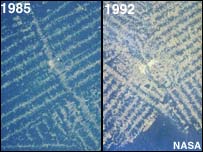
 In pictures

