
|
 |
 | | | | | | ||||||||||||||||||||||||||||||||||||||||||||||||||||||||||||||||||||||||||||||||||||||||||||||||||||||||||||||||||||||||||||||||||||||||
| | | You are in: Talking Point: Forum: Six Forum | ||||||||||||||||||||||||||||||||||||||||||||||||||||||||||||||||||||||||||||||||||||||||||||||||||||||||||||||||||||||||||||||||||||||||||
|
| | Thursday, 17 October, 2002, 10:28 GMT 11:28 UK Six forum: Road congestion 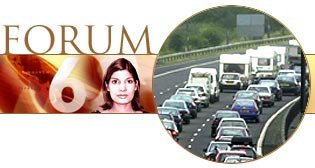
The government is to spend �145m to reduce traffic jams and accidents on England's roads. New roundabouts and lane markings will be put in place to improve conditions on trunk roads and motorways. But some of the government's critics have accused it of tinkering while the country grinds to a halt. And BBC transport correspondent Tom Symonds says the big decisions have not been made - in particular whether to build a string of new roads and bypasses, and whether to widen a number of A roads. What do you think of the government's plans? How will the changes affect you? Steve Hounsham from Transport 2000 answered your questions in a forum for the BBC's Six O'Clock News, presented by Manisha Tank.
We start with an e-mail from Dave Spencer, Leicester: What's the timescale for these improvements? But is it just a fleabite when real action is needed? There's a real feeling that the Government is fudging this issue.
In the long-term if we really want to affect congestion, we're going to have to tackle the root, fundamental cause - which is that there is simply too much traffic on our roads. Until we actually start to reduce traffic, we not going to see those traffic jams get any shorter.
There's a lot of work also that needs to be done to improve the environment for pedestrians and cyclists. What we've got to do is to improve choice and that way more motorists would decide to use their cars less of the time and the traffic jams can actually get shorter.
Guy Chapman, Reading, UK: How are these new proposals different from the attempts to build our way out of congestion which failed so consistently in the 1980s and the early 1990s? Surely the evidence shows that building new roads creates more traffic rather than reducing congestion.
These short-term, fairly small scale measures might have an impact on congestion and safety in the short-term and I believe the Government wants to be seen to be doing something - and what's wrong with that. But in the long-term it can't get away from the main point that it must reduce traffic.
There seems to be a massive gap in research and development in trying to figure out what it is we need on our roads.
However, as soon as the extra road space was provided, it simply filled up with traffic and in that way they found that three lanes on the M25 was not enough and they needed to put another one on. Of course now they realise that four lanes on the south western section is not enough either. But we can't go on in that direction. It is not the way to achieve a real solution.
I think also what Mr Toon is trying to point out is perhaps we should be going back sometimes to the basics of our Highway Code - they are there for a reason, these rules.
I agree drivers should be careful drivers, they should drive as near to the left as possible and only use the faster lanes when overtaking - that seems commonsense. But I don't think - even if all drivers did follow those rules - it will lead to a very great improvement in terms of congestion.
However, it's difficult to see how else they can reduce the amount of traffic on our roads but certainly they have indicated they want to improve public transport but they really do need to take on the motorist head on as well and try to get them to use their cars less.
A number of people have written in about this point that more of that freight traffic needs to go onto the railway system as opposed to being on these trucks.
What we need to do is to encourage more companies to look at rail freight and we need to encourage more local authorities to set up the infrastructure and the conditions under which that form of freight carriage could thrive.
So it is rather swings and roundabouts - in some cases it would be good to reduce the daytime congestion on our roads. But there's no point in solving that problem by creating another one of great disturbance at night to local residents.
The number of 63% of you have said you would not be willing to pay those tolls. Steve, is that the kind of result you would expect?
I think there is a growing consensus that we are coming round to the idea of fairly broad based area charging in all parts of the country. Obviously in London, congestion charging will start next February and I think a lot of councils around the country will be watching closely to see whether that is successful. Assuming it is successful - and I hope it is - then I think a lot more local councils will be bringing congestion charging in their own areas. No motorist likes to dig into their pocket if they don't have to. But I think provided the message goes out that really there is no alternative if we want to reduce congestion. And so long as people understand that their concerns that the money should go towards public transport are being met, then I think that people will be broadly in favour in the long term.
But a lot of people think that all money raised by motoring taxes should therefore be spent on road building for example. But this is like suggesting that all money raised on beer should go towards building new breweries. Of course it doesn't happen. This is general taxation raised by the Government for a whole range of purposes. But I think more of it should go on improving public transport and the street environment.
This is a problem that has been a long time in the growing. There is no obvious way of combating it other than to try to reduce the amount of cars that people feel compelled to use. If more people were satisfied with public transport and found that it met their needs then I think that fewer people would be rushing out and buying a car when they're 17 or 18.
I think also the point being made here is again measures that can reduce the number of cars on the road, for example, car pooling is a very good way to reduce traffic.
So clearly here is a problem that's snowballing and getting bigger and bigger. But lots of schools are tackling the school run. In many parts of the country, schools, local authorities and parents are working together to set up safe routes to school - routes where children can walk in greater safety and don't actually need to be driven to school by their parents. But there's a long way to go. A key part of making the road safer for children is of course reducing the danger from traffic and I think we need to look at lower speed limits in more places - especially around schools.
There are other things as well - such as working from home and telephone conferencing - things that mean you don't have to get in your car and drive to a work place or on a business trip and that you can do it in other means that don't involve generating traffic. There are a lot of ways that we could organise working life better I think and the transport options that are available in terms of going to work and travelling around during work time. I think they could make a real contribution to sorting out congestion problems.
Just to let you know, the online viewers, the vote that has been ongoing has now swung the other way. We're now reporting that 58% of you would pay for toll roads. Maybe you've been listening to the forum and have changed your minds. | | See also:  16 Oct 02 | UK 16 Oct 02 | UK 15 Oct 02 | England 14 Oct 02 | England 11 Sep 02 | Politics Internet links: The BBC is not responsible for the content of external internet sites Top Six Forum stories now: Links to more Six Forum stories are at the foot of the page. | ||||||||||||||||||||||||||||||||||||||||||||||||||||||||||||||||||||||||||||||||||||||||||||||||||||||||||||||||||||||||||||||||||||||||
| |
|  E-mail this story to a friend E-mail this story to a friend |
|  |
| Links to more Six Forum stories |
| | | ||
 | ||||
 | | Back to top
| ||
| ---------------------------------------------------------------------------------- To BBC Sport>> | To BBC Weather>> | To BBC World Service>> ---------------------------------------------------------------------------------- © MMIII | News Sources | Privacy  |





