The incredible biodiversity of the Galapagos Islands was key to shaping Charles Darwin's theory of evolution.
Two hundred years on from the birth of Darwin, BBC science correspondent David Shukman visits the archipelago.
Use the map below to move around three of the main islands. Click on the icons to see how the wildlife and landscape informed the scientist's great discoveries.
David Shukman reveals how lava became a key geological feature of the Galapagos Islands.
id
boobies
type
image
width
488
top
2
left
auto
The Galapagos Islands are rich in biodiversity
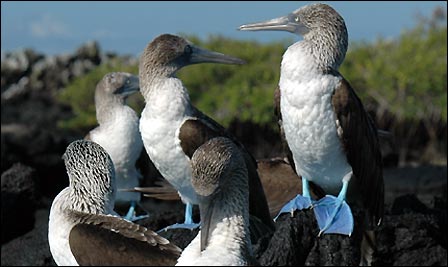
Blue-footed boobies are a common sight on the Galapagos Islands. Males perform an elaborate dance where they flaunt their brightly coloured feet to attract females.
id
darwin
type
text
width
488
top
auto
left
auto
Darwin's big mistake
It must have been agony for the young scientist. After five years of arduous seafaring, generating one of the great natural collections, Darwin realised his notes from the Galapagos were missing a rather important fact: the locations of some of his most important samples. As a diligent naturalist, he had collected even the seemingly duller, less remarkable birds, including various finches - but he had not recorded what islands he had found them on. An expert later identified the finches as belonging to no fewer than 13 different species, with different beaks suited to different ecological niches, but Darwin had to admit that "unfortunately most of the specimens of the finch tribe were mingled together". Sadly the 40-odd adult tortoises brought on board were no use either; they were eaten, and their shells, further evidence of the emergence of separate species, were thrown away. Luckily, Darwin had enough other clues to develop his theory of evolution.
All this week, BBC News will be reporting from the Galapagos Islands.
Text by David Shukman, photographs by Mark Georgiou and video by Rob Magee
 One-Minute World News


 E-mail this to a friend
  Printable version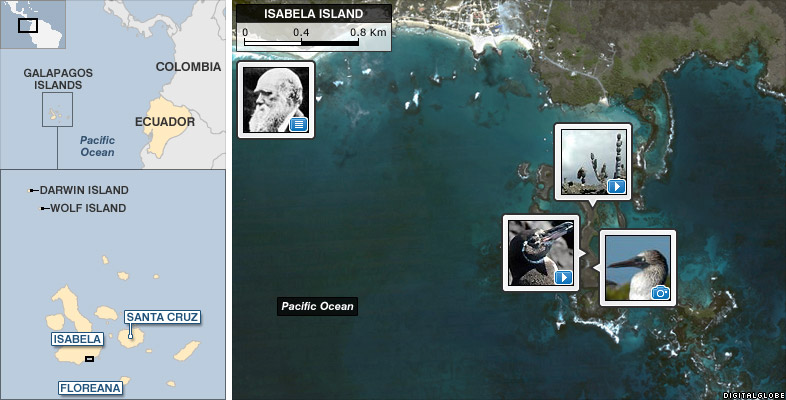



 BBC News


Bookmark with:
What are these?