Scientist Dave Barney wonders where the antimatter's gone
The LHC Beauty (LHCb) detector is designed to answer a specific question: where did all the anti-matter go?
Equal amounts of matter and its opposite counterpart anti-matter were created in the Big Bang. But today we find no evidence of, for example, anti-matter galaxies or stars.
In order to do this, the LHCb will investigate the slight differences between matter and antimatter by studying a type of particle called the "beauty quark".
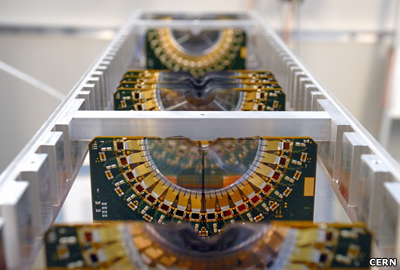
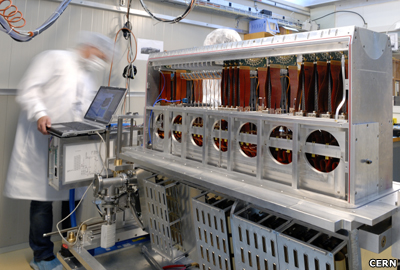
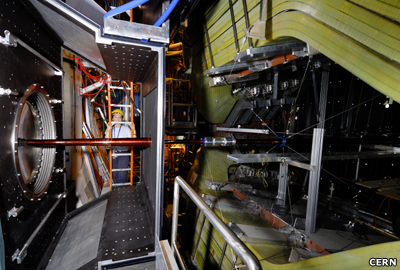
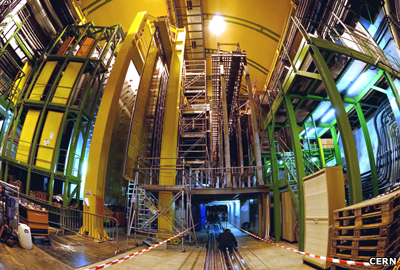
Instead of surrounding the entire collision point with an enclosed detector, like Atlas and CMS, the LHCb experiment uses a series of sub-detectors.
The first sub-detector is mounted close to the collision point, while the next ones stacked one behind the other, over a distance of 20m (66ft).
The Large Hadron Collider will produce many different types of quark when the particle beams collide.
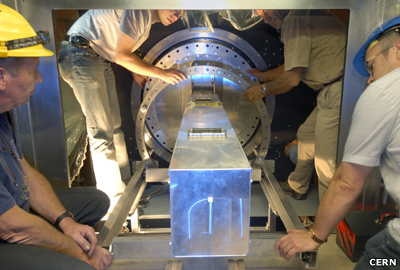
In order to catch the beauty quarks, LHCb has developed sophisticated movable tracking detectors close to the path of the beams circling in the Large Hadron Collider.
LHCb FACTS
Size: 21m long (69ft), 10m (33ft) high, 13m (43ft) wide
Weight: 5,600 tonnes
Design: Forward spectrometer with planar detectors
 One-Minute World News




Bookmark with:
What are these?