 The Orangemen marched to the security barrier |
The annual Orange Order parade in Drumcree has passed off peacefully amid tight security. About 700 Orangemen and band members took part in the parade to Drumcree Church in County Armagh on Sunday.
The Orangemen's parade followed their annual service at the church which commemorates the anniversary of the battle of the Somme.
A delegation from Portadown District Orange Lodge marched to a security barrier at Drumcree Church where they were stopped from returning to Portadown via the mainly nationalist Garvaghy Road.
The Parades Commission ruled the parade must use an alternative route after the Garvaghy Road residents objected to the march.
The Orangemen handed a letter of protest to a police chief superintendent at the barrier.
The parade then dispersed.
Later on Sunday the security operation, which is believed to have cost about �500,000, was scaled down.
Speaking afterwards Assistant Chief Constable Stephen White said people had acted responsibly.
See the full route of the Orange Parade 
|
"The key difference this year, I believe, is that people took responsibility for the people that they have here today," he said.
A spokesperson for the Orange Order appealed for a peaceful protest.
There was no repeat of the trouble seen in previous years which has seen both the police and Army come under attack.
Security Minister Jane Kennedy commended all those who ensured the parade passed off peacefully.
"Everyone with the best interests of Northern Ireland at heart will be pleased that Drumcree has passed without incident," she said.
Last year, a scaled down security operation had to be rapidly reinforced when trouble broke out.
Earlier, hundreds of Orangemen and band members left Portadown town centre for Drumcree Church at about 1030 BST on Sunday.
Before setting off, Deputy District Master David Burrows denounced the Parades Commission as "an unelected quango".
Police and troops were positioned along the two-mile march route and two water cannon were brought in to the area.
Two police CCTV cameras are in position to identify any potential trouble makers.
Troops used heavy earth moving equipment on Saturday to place concrete blocks around St John's Roman Catholic church at the top of the Garvaghy Road.
SDLP deputy leader Brid Rodgers said it was a problem that could only be solved between neighbours locally.
"If everyone sits down together, I believe an accommodation - if it is agreed mutually between both sides, I believe we will have cracked the Drumcree issue," she said.
Residents' consent
County Armagh members of the Protestant Orange Order gave their backing for proposals aimed at ending the dispute at a meeting in Portadown on Thursday night.
The proposal is that the march would bring to an end the protest which began in 1998 at Drumcree Church, when the homeward route of the Orangemen was blocked by the security forces.
In future years, Portadown district lodge would continue to apply to walk its traditional route but accepts the agreement of the residents would be required.
If that consent is withheld, there would be no resumption of the Drumcree protest.
The Orangemen said they are awaiting a response from the government to the proposals.
Garvaghy Road residents spokesman Breandan MacCionnaith said the residents group had not been involved in talks so far.
A number of sources told the BBC they believed the proposals, which mark a significant shift in the local Orange position, had come too late to resolve this parade, but said it could be the basis for future discussions.
Meanwhile, the president of the Methodist Church in Ireland, the Reverend Jim Rea, who is also a minister in Portadown, has said the Grand Orange Lodge should support the Portadown Orangemen in their efforts to resolve the impasse.
Speaking to BBC Radio Ulster's Sunday Sequence programme, Mr Rea said that the Orange Order and the Garvaghy Road residents should engage with one another to find a solution.
The Parades Commission was set up in 1997 to make decisions on whether controversial parades should be restricted.


 One-Minute World News
  News services
 E-mail this to a friend
  Printable version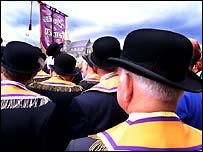
 In detail


