Dementia is not part of aging naturally, but caused by disease. A healthy body can help protect your brain.
What can you be doing to reduce your risk of dementia?
This quiz is an informal guide based on the findings of a BBC commissioned panel of independent experts, chaired by Alzheimer's Society. The panel reviewed key scientific papers and gave their opinion on what lifestyle factors can help reduce risk.
This quiz is intended for general information only. It should not be treated as a substitute for the medical advice of your own doctor or any other health care professional. It is not a diagnostic tool.
Ensuring cholesterol is kept at a healthy level throughout mid-life (aged 35-65) can help reduce the risk of dementia.
A diet low in saturated fats – those found in cheese, cakes and fried food, for instance, as well as treatment with statins – can help lower cholesterol.
Obesity, rather than just being a little overweight, increases the chance of developing Type 2 diabetes, a condition linked to dementia. Being obese also increases the likelihood of having high cholesterol and high blood pressure, which are known to be risk factors.
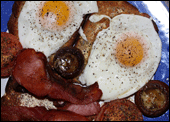
Do you eat a Mediterranean diet, one with lots of whole grains, fish, and olive oil?
A few studies have shown a Mediterranean diet may be beneficial. This is a healthy, balanced diet, which relatively low in dairy products and processed food.
Some evidence suggests that an active social life throughout life can be beneficial. This is defined as both the ties you have with others and what you do in your leisure time.
One study suggests that engaging in leisure activities, such as odd jobs, gardening, knitting, may be protective.
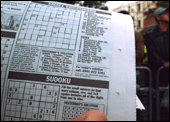
The evidence is very limited to whether crosswords and number puzzles can help protect from dementia. This does not mean to say that they don't – just that any proof is currently lacking.
The results suggest your lifestyle may be increasing your risk of dementia by up to 20%.
However, this is only a rough estimation. There is good evidence to suggest that adopting a healthy lifestyle might, in the long term, help reduce your risk of dementia – but there is no fail-safe way to avoid the disease for certain.
Slightly above average risk
The results suggest your lifestyle may be slightly increasing your risk of dementia.
However, this is only a rough estimation. There is good evidence to suggest that adopting a healthy lifestyle might, in the long term, help reduce your risk of dementia by up to 20% – but there is no fail-safe way to avoid the disease for certain.
Average risk
The results suggest your lifestyle gives you an average risk of developing dementia.
However, this is only a rough estimation. There is good evidence to suggest that adopting a healthy lifestyle might, in the long term, help reduce your risk of dementia by up to 20% – but there is no fail-safe way to avoid the disease for certain.
Slightly below average risk
The results suggest your lifestyle may be slightly decreasing your risk of dementia.
However, this is only a rough estimation. There is good evidence to suggest that adopting a healthy lifestyle might, in the long term, help reduce your risk of dementia by up to 20% – but there is no fail-safe way to avoid the disease for certain.
Below average
The results suggest your lifestyle may be decreasing your risk of dementia by up to 20%.
However, this is only a rough estimation. There is good evidence to suggest that adopting a healthy lifestyle might, in the long term, help reduce your risk of dementia – but there is no fail-safe way to avoid the disease for certain.
 One-Minute World News


 E-mail this to a friend
  Printable version







 BBC News


Bookmark with:
What are these?