By Chris Clayton
BBC News Interactive |

 Orville and Wilbur Wright faced a race to be first to fly |
On 17 December, 1903, at a remote fishing village in the United States, two bicycle shop owners changed the world for ever - they flew the first aeroplane.
After four years of experiments, the Wright brothers' first flight lasted 12 seconds, travelled 120ft - less than the length of a Boeing 747 - and their Flyer never rose more than a few feet off the ground.
None the less, it was the first time man had achieved a controlled, powered flight in a machine that was heavier than air. And many of the features Wilbur and Orville Wright designed for the 1903 Flyer are still used in aeroplanes today.
The brothers' interest in flying started in 1878 when their father, Milton, gave them a rubber-band-powered toy helicopter which 12-year-old Wilbur and eight-year-old Orville copied.
Formal declaration
In 1893, the brothers opened the Wright Cycle Company in their hometown of Dayton, Ohio.
Much the pair learned about bikes - the need for a strong, light design, the importance of balance and control and wind resistance - was to prove invaluable.
Six years later, Wilbur formally declared their interest in aviation in a letter to Washington's Smithsonian Institution asking for previous research.
He wrote: "I am an enthusiast, but not a crank. I wish to avail myself of all that is already known and then, if possible, add my mite to help... attain final success."
 | FIRST FLIGHT The Flyer weighed 341kg - including the pilot It was 6.4m long with a 12.3m wingspan The right wing was four inches longer than the left one to counter the engine weight A Boeing 747 is 225ft long - 100ft longer than the first flight |
The brothers also made one of their key breakthroughs in 1899 - a light method of controlling balance and turning the aircraft which they called wing-warping.
While fiddling with the box for a bicycle inner tube, Wilbur realised that if it was twisted lengthwise, one side would be higher than the other. If the same effect was applied to a wing, one side would hit the air at a greater angle than the other, generating more lift on that side.
The brothers tested the idea on the 1899 Wright Kite and, buoyed by its success, began developing full-size gliders.
Testing time
Over the next three years, Wilbur and Orville built three gliders and tested them at Kitty Hawk in North Carolina.
They picked the fishing village because its steady winds would help them get airborne and its soft sandy beaches would cushion their landings.
|  If you are looking for safety, you will do well to sit on a fence and watch the birds; but if you wish to learn, you must mount a machine and become acquainted with its tricks If you are looking for safety, you will do well to sit on a fence and watch the birds; but if you wish to learn, you must mount a machine and become acquainted with its tricks  |
The first two gliders, tested in 1900 and 1901, showed wing-warping and the elevators added to control ascent and descent worked, but did not provide enough lift.
To resolve this problem, they built a wind tunnel and tested 200 wing shapes before settling on the best design for their third glider.
Propulsion system
They also added a vertical rudder to correct a tendency the second glider had shown of lurching in the wrong direction - it was a success.
The rudder completed a three-axis control system, making the 1902 glider their first fully controllable aircraft, and the brothers made hundreds of flights in it.
Finally, they turned their attention to power.
Car makers could not provide a sufficiently light and powerful engine so they decided to build one themselves.
Equally important was their decision to treat the propeller as a rotating wing, reasoning that it would create propulsion in the same way that a wing produced lift.
First flight
In September 1903, the brothers returned to Kitty Hawk with the Wright Flyer - and found themselves in a race to be first.
Samuel P Langley, secretary of the Smithsonian Institution, had built his own craft and had time to test it before the brothers' return.
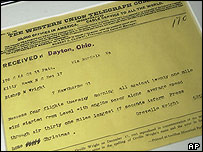
The brothers sent their father a telegram to announce the news 
|
Bad weather and technical problems delayed the Wrights' attempt until Sunday, 13 December. Then they waited an extra day because their father, a United Brethren Church bishop, would not have approved of them flying on a Sunday. In the meantime, Langley had failed to get his plane airborne, leaving the brothers a clear field.
On 14 December, Wilbur won the right to pilot their one-man plane on the toss of a coin. The Flyer rolled down its launching rail, took to the air, stalled and crashed.
Three days later, after they completed repairs, it was the younger brother's turn to try and, at 10.35am, despite a 27mph wind, Orville climbed onto the Flyer and made his historic 12-second flight.
The pair made three more flights that day and the last, with Wilbur at the controls, lasted 59 seconds and covered 852 feet.
The aviation age had begun.
Hear the story of that historic first flight at Kitty Hawk: The Wright Brothers - First Flight Special, BBC Radio 4, 17 December, 2100-2130 GMT.


 One-Minute World News
  News services
 E-mail this to a friend
  Printable version
 Enlarge Image


 Making use of aircraft

