
Last updated: 19 january, 2011 - 14:55 GMT
Dangers of reporting in the Philippines
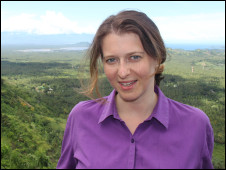
BBC correspondent Kate McGeown on the island of Mindanao in the Philippines
BBC correspondent Kate McGeown describes the challenges of planning a safe trip to the war-torn Philippine island of Mindanao, where an ongoing guerrilla conflict puts the lives of local journalists at risk every day.
Every Philippine journalist knows that a large number of their daily news stories are likely to come from the southern island of Mindanao.
A beautiful island, it makes up nearly a third of the Philippine landmass, but it also has a lot of problems – most notably the ongoing communist and Islamic insurgencies in the west, and the huge amount of power wielded by certain families and their private militias.
The danger that journalists – especially local journalists – face was highlighted by the Maguindanao massacre in late 2009.
Fifty-seven people were killed, more than 30 of them reporters and cameramen.
They were the alleged victims of one powerful family trying to prevent another from running in a local election.
It might have been an extreme incident, but it was not an isolated one.
Lack of information
We were told it was pure coincidence that these rallies were happening while we were there, but one placard that read Welcome BBC would perhaps suggest otherwise.
BBC correspondent Kate McGeown
Statistics show that, in the past few years, journalists in Mindanao have faced just as much danger as their counterparts in Iraq or Afghanistan.
Yet far less is known internationally about Mindanao, mainly because the vast majority of its problems do not spill out into other parts of the world.
In fact, when I told my friends and colleagues that I was going to interview the MILF, many of them smirked slightly, thinking of anything but the Moro Islamic Liberation Front, the Islamist rebel group which has been waging an on-off insurgency on the island for nearly 40 years.
In terms of information and safety advice about the island, few international organisations have extensive and current information.
But with the help of other journalists, non-governmental organisations, the BBC’s High Risk Team and safety advisors from the United Nations - who maintain a permanent presence in the region - we were able to report on the MILF insurgency and produce a piece to mark a year since the Maguindanao massacre.
Prior warning
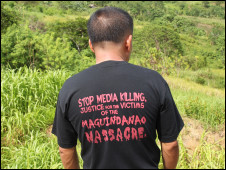
Journalist wearing a "Stop media killing" T-shirt at the scene of the Maguindanao massacre
To cover the story, we were helped by a local fixer who advised us to take a military escort with us to the massacre site.
The site itself is a beautiful, tranquil spot and you can hardly imagine that the holes in the ground were once mass graves.
More than half of those suspected of being involved in the massacre are still on the run – perhaps in the nearby hills, which are also known to harbour Islamic rebels.
For our report, we had to take slightly different precautions. Our main priority was to make sure that all our plans had been conveyed to MILF sentries before we crossed from a government-held area into rebel territory.
Extensive preparation
The group itself is very media-friendly and well aware of the benefits of a good photo opportunity.
As we travelled to their base and toured their internally displaced person (IDP) camps, we repeatedly drove through groups of people protesting against government inaction in the peace process.
We were told it was pure coincidence that these rallies were happening while we were there, but one placard that read Welcome BBC would perhaps suggest otherwise.
It took at least a month to get everything in place for our week-long trip, with the safety aspects taking by far the longest time to arrange.
We chose not to use local transport (extortion gangs frequently target buses) and made sure we were off the road well before nightfall.
Walking a tightrope
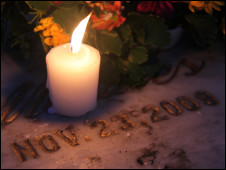
Candle at the grave of a journalist killed at the Maguindanao massacre
We met a local journalist, Malu Manar. She receives several death threats a year and her husband picks her up from work at night carrying a gun.
She even had to move to a different city a few years ago, because unknown assailants tried to abduct her daughters from school.
She tries to stay as safe as she can, varying her daily routine and phoning in advance to warn people that she’s coming. But even so, she faces risks on a daily basis.
We followed her for a day while she was investigating the murder of a man thought to be an army informant, allegedly by sympathisers of the communist rebels.
Malu had phoned the village leader, the bereaved family and the communists well in advance, but she hadn’t anticipated the army turning up as well.
An initially tense moment was quickly resolved, but every day Malu has to walk a tightrope between opposing sides and, inevitably, not everyone is always happy with the result.
Media attention
Mindanao is a fascinating and under-reported region.
And while it’s true that most of the violence only affects those living in the immediate area, neighbouring countries and the wider world can’t afford to simply ignore what’s going on there.
Several terrorist suspects on international wanted lists are known to have sheltered there in the past. The more unstable an area is, the more effective a haven it is for those seeking to evade the law.
So perhaps the world’s media should pay more attention to this beautiful yet troubled part of the Philippines.
To watch Kate's news report, 'The long wait for justice after Philippines massacre', click click here
Also on World Agenda


BBC World Service highlights



BBC iD
BBC iDBBC navigation
BBC links

BBC © 2014The BBC is not responsible for the content of external sites. Read more.
This page is best viewed in an up-to-date web browser with style sheets (CSS) enabled. While you will be able to view the content of this page in your current browser, you will not be able to get the full visual experience. Please consider upgrading your browser software or enabling style sheets (CSS) if you are able to do so.
