
Last updated: 22 november, 2010 - 10:24 GMT
Visiting the world’s most deadly roads
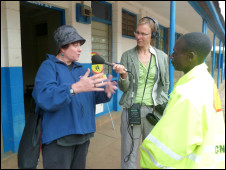
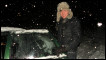
Road Kill presenter Sheena McDonald and producer Kirsten Lass interview a lollipop man in Nairobi, Kenya
Producer Kirsten Lass describes the difficulties she and presenter Sheena McDonald experienced on the dangerous highways of Kenya and Costa Rica, investigating why road deaths in developing countries are on the increase.
It's six in the morning, and it's cold and dark.
I am standing on the edge of a busy road in central Nairobi in Kenya with my presenter Sheena McDonald. We are recording for the documentary we're making on road safety – but it's not going well.
Teetering on a muddy hillock that serves as the kerb, Sheena grabs me.
Stand back! she yells, as a bus careers past us just inches away.
Sheena was knocked down by a police car in London more than a decade ago and is understandably wary near roads.
A group of children is gathering to cross the road. We are next to a primary school and these children are trying to get to class. One by one they dart across the road.
Do you do this every day? Sheena asks a smartly uniformed girl. Yes, she replies. "Are you scared?" "Yes," she says again, emphatically.
Taking risks
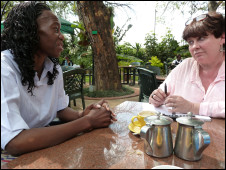
Road safety campaigner Bright Oywaya of charity ASIRT Kenya speaks to Sheena
The statistics for road deaths are unreliable in Kenya, but according to the World Health Organisation, traffic kills 120,000 school children every year.
That’s more deaths than result from HIV/AIDS and malaria – and the numbers are increasing.
But it’s not just children. Adults are also dying in huge numbers and it’s not hard to see why. We watched men and women running across four-lane highways. We saw cars driving down pavements to beat the traffic jams.
Terrifying journey
For the making of the programme, we decided to travel by matatu - a small minibus that is the main form of public transport in Kenya.
They dominate the roads and their drivers often seem beyond the law.
We hopped aboard one that stopped just long enough for us to get on. As Sheena chatted into the microphone, I could barely hear her. The door was open next to me and I had nothing to hold on to.
Travelling at 50mph, I knew it would take just one big jolt and I’d be thrown out. It was terrifying, but for Kenyans it was normal.
Casual attitude
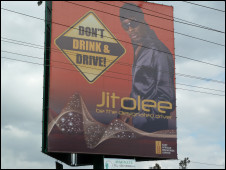
A road safety advert in Kenya
The week before we had flown out, I had been talking to Casey Marenge, a 27-year-old quadriplegic, herself disabled in a car crash.
Her charity Chariots of Destiny educates young adults about the dangers of the roads. On our arrival we learnt that one of the girls she had lined up to talk to us had been killed.
This young girl had boarded a boda boda – a motorbike taxi – and a car driving without lights had crashed into them. Sheena asked if she had been wearing a helmet. Of course not, replied Casey. This is Kenya.
Time and again we were shocked by the ways people used the roads and by the casual attitude of politicians when questioned by Sheena about the need for change.
"Yes, we are dealing with it", they would say, and then point us in the direction of the next agency or minister.
Fruitless efforts
The United Nations is so alarmed at the rising death toll – mostly in developing countries – that it is launching the Decade of Action for Global Road Safety, aiming to save five million lives by 2020.
Road Kill producer Kirsten Lass
In Costa Rica the attitude is very different. This is a country that is far smaller than Kenya and has launched road safety initiatives in the past that have attracted worldwide attention.
The chief of traffic police Cesar Quiros took us to see the new privately-built bypass that connects San Jose to the town of Caldera on the Pacific Coast.
The police showed us how rain had ravaged the road and the fruitless efforts the construction company had made to try and drain it.
Collapsed road
The public was angry about this road. Sheena and I were allowed into a press conference where journalists were holding President Laura Chinchilla and her deputy transport minister to account. The anger in the room was palpable.
Afterwards, we were promised an interview with the president – a sign of how seriously this country takes road safety. Her assistant took us through a labyrinth of back corridors to her office, but then she took a phone call and shook her head.
It’s not possible today, she said. There’s an emergency. Dona Laura has had to leave urgently.
We later found out that the Caldera bypass had collapsed and Laura Chinchilla had boarded a helicopter to witness the damage for herself.
Complex solutions
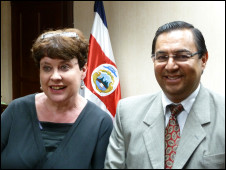
Sheena McDonald meeting Costa Rica transport minister Francisco Jimenez
When we met the Transport Minister Francisco Jimenez, he acknowledged that Costa Rica was facing a challenge and told Sheena that road safety is a big responsibility – it’s a task not just of one government but of a whole generation.
The United Nations is so alarmed at the rising death toll – mostly in developing countries – that it is launching the Decade of Action for Global Road Safety, aiming to save five million lives by 2020.
What we realised, after our trips to Kenya and Costa Rica, was how simple road safety sounds, but how complicated it is to achieve.
To listen to the two-part documentary Road Kill, click click here
Also on World Agenda

BBC World Service highlights



BBC iD
BBC iDBBC navigation
BBC links

BBC © 2014The BBC is not responsible for the content of external sites. Read more.
This page is best viewed in an up-to-date web browser with style sheets (CSS) enabled. While you will be able to view the content of this page in your current browser, you will not be able to get the full visual experience. Please consider upgrading your browser software or enabling style sheets (CSS) if you are able to do so.
