Major new projects in Nigeria, Burma and Cambodia were
launched by the BBC World Service Trust, a charity that aims
to reduce poverty in developing countries through innovative
use of the media.
In Nigeria, attention focused on Voices, a three-year public
education project which combines radio drama and
discussion programmes in English, Hausa, Igbo and Yoruba
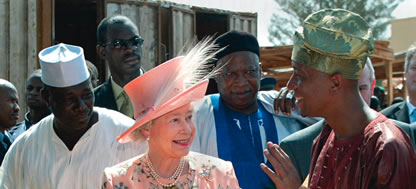
languages. Her Majesty the Queen visited the set of the
project's new radio drama Story, Story - Voices from the
Market in December 2003. She saw an episode of the
drama recorded in which actors representing every part of
the community face the same issues as millions of ordinary
listeners. Follow-up discussions are broadcast on the BBC
and local stations. Training for local broadcasters forms an
integral part of the project, which is funded by the UK's
Department for International Development.
'The series is broadcast across West Africa. It is firmly rooted
in Nigeria and produced there using a Nigerian production
team and actors,' says Stephen King, Director of BBC World
Service Trust. 'It deals with a whole range of issues from local
corruption and over-charging to health and how to avoid
disease, all wrapped up in entertaining storylines. We worked
closely with local drama teams to devise the ideas.'
Around the world, the Trust now has 400 staff working
on projects in partnership with local and national NGOs,
broadcasters and governments. Funding from UK
government sources, international agencies and other
partner organisations reached a record £10.2 million
in 2003/04, up from £4.2 million three years earlier.
Radio soaps in local languages are a highly effective and
flexible format. The trailblazer – Afghanistan's New Home,
New Life – celebrated ten years on the air in 2004.
Broadcast in Pashto and Dari, it has entertained millions
of listeners while helping them to survive in often hazardous
circumstances. It is now reflecting the changes taking place
in a society emerging from two decades of war.
Burma's soap, Eugenia Tree Village, launched in 2003 to target
Burmese audiences, combines the intrigues of rural life with
information about social rights and responsibilities, education
and health.
In Cambodia, work began on the country's first indigenous
TV drama. Set in a nurses' residential home it will explore
social and health themes. The young team of writers and
actors has been trained from scratch and a mini "Hollywood-style"
studio built in Pnomh Penh.
In India the award-winning interactive television drama
Jasoos Vijay returned for a second series. There are
125 million viewers for this action-packed show, named
after the detective who not only solves crimes but
raises awareness about HIV/Aids, sexual health and other
social issues. Made in partnership with the Indian national
broadcaster, Doordarshan, and India's National Aids
Control Organisation, it is part of a major initiative to
combat HIV/Aids in India, which also features a reality
TV show for a youth audience, a weekly radio phone-in
and TV and radio advertising spots.
'The show works as an entertainment vehicle in its own
right but also has a very serious side to it as well,' explains
Roy Head, Health Director, BBC World Service Trust.
'It demonstrates how imaginative ways of using the media
to target specific audiences can help to dispel myths and
encourage ordinary people to change their behaviour.'
Strengthening independent media has high priority in
countries where years of conflict have taken their toll.
In Iraq, as in Afghanistan, the emphasis is on helping
to re-establish local radio and TV through training in
journalism and media skills.
A fact-finding mission showed that Iraqi broadcasters had
technical skills but less understanding of editorial impartiality
or how to put across opposing views. 'We have found a
massive thirst for knowledge and training in Iraq,' says
Stephen King. 'Now we have begun delivering that training
and are working with local communities on a project to help
re-establish Iraqi-run radio and television in Basra in southern
Iraq during 2004.'
Iraqi journalists are being trained through projects such
as Calling Iraq, a series providing information and help
about security, health and humanitarian issues. Broadcast
on the BBC Arabic Service, it features local people talking
about how they are rebuilding their lives and the problems
they face.
Elsewhere, a year-long programme has begun to train
journalists from countries across the Middle East and
North Africa. A new training programme for journalists
in Sudan started in 2003 and the second phase of the
scheme is underway in Somalia.
|  | | | | A year in review | | | | | | BBC World Service Trust | | | | | | | | | | | |
|