Thursday 27 September, 2001
Chemical weapons of war
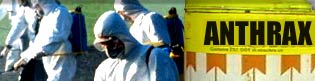
In the wake of the devastating aircraft hijackings in the US, security forces are now seriously considering the threat of chemical and biological warfare.
In recent days, a total of 29 people in America have been arrested for illegally obtaining licences to transport hazardous materials in trucks.
BBC Science looks at chemical and biological weapons and considers the consequences of what could potentially be a public health emergency.
Rational fear

The arrests in America have been fuelled by the suspicion that the people involved in the 11th September 2001 attacks on the World Trade Centre and the Pentagon may have been planning further operations using chemical or biological weapons.
The Federal Bureau of Investigation (FBI) recently confirmed that Mohammed Atta, one of the suspected hijackers who is believed to have piloted a jetliner into one of the twin towers, was acquiring knowledge of crop-dusting aircraft prior to the devastating attack.
Atta was reported to have visited an airport in Florida where he enquired how far crop dusters could fly and requested details of their carrying capacity.
The FBI also revealed that another individual was found to have researched the aerial application of pesticides and that an official in Pennsylvania had issued a number of transportation licenses to people who were not eligible for them.
While authorities have yet to establish a link between the 29 detainees and those behind the US hijackings, they are not taking any chances.
Counter attack
As a result of the FBI findings, over 4,000 crop dusting aircraft in America have been grounded and the World Health Organisation (WHO) has urged western countries to begin to prepare for what might be a public health emergency.
WHO argues any deliberate use of an agent, such as anthrax, should be met with an effective response from the public health sector.
Dr David Nabarro, its executive director, recently announced WHO has been trying to obtain up-to-date information on the kinds of agents that might be used and the types of vaccination, treatments and medical facilities that might be used to combat a disease. He added:
| ‘It might be anthrax or botulism, the toxin that comes from a bacterium and that causes paralysis or possibly smallpox…’ |
|
‘Because we don’t know enough about what’s involved in using these agents effectively to cause harm, we’re suggesting people take the risk seriously… it might be much easier than the use of other forms of potential terrorist weapon.’
Guidelines for containing disease outbreaks – whether caused by anthrax or other toxins or chemicals – are now available to the medical profession through the WHO website.
Chemical weapons
Chemical weapons are the oldest of the so-called weapons of mass destruction, having been widely used in the grim trenches of World War I.
One of the substances used then, phosgene, is now a commonly used industrial chemical and would be easy to obtain.
More modern agents include sarin, a nerve gas, which was used in 1995 by followers of the Japanese doomsday sect AUM Shinrikyo in a Tokyo subway.
| Five cult members carried the liquid gas in plastic bags into crowded trains. They then punctured the bags with the sharpened tip of an umbrella, thereby releasing the deadly gas. |
|
Twelve people died and at least 5,000 were injured in the act of terror.
Sarin is hard to obtain; but experts say it could be made easily by a competent chemist.
The main advantage of any chemical weapon is that if it is carried inside a sealed container, it is almost impossible to detect.
Biological weapons
To carry out an effective biological attack, an individual would have to obtain a virulent biological strain of anthrax, for example, and grow sufficient amounts of its spores.
According to the US scientific journal New Scientist:
| ‘Processing the spores so they distribute efficiently, get inhaled and remain in people’s lungs long enough to cause an infection would also take expertise… ’ |
|
Anthrax is one of the world’s most deadly diseases; the anthrax bacterium invades the lungs and poisons the blood. However, it can be treated using antibiotics.
The Centre for Applied Microbiology and Research, based in Wiltshire, UK, recently produced tens of thousands of doses of anthrax vaccine in the fight against biological warfare.
Both chemical and biological weapons are most effective when delivered as fine sprays, which is why the US government grounded crop spraying aircraft earlier this week. Using lorries to deliver the weapon to its target would be far less effective.
|  |  | | | Nerve gas |  |
| | Iraq is believed to have produced mustard gases and a deadly nerve gas called VX.
In August 1988, Iraqi forces were reported to have used both chemical and gas munitions against Kurdish civilians in Iraqi Kurdistan. |
|  |
| | | | Releasing anthrax |  |
| | Colonel Edward Eitzen, head of the US Army Medical Research Institute of Infectious Diseases said recently that a release of anthrax bacteria near a city of half a million people would cause up to 90,000 deaths within a week.
Fear of a chemical or biological attack has resulted in the increase in sales of gas masks and protective suits both in America and the UK.
However, in a recent interview with New Scientist, John Eldridge, editor of Jane's Nuclear, Biological and Chemical Defence warned:
‘A mask is only effective if you put it on beforehand. Otherwise you're locking the stable door once the horse has bolted.’
Eldridge also noted, gas masks do not protect against agents that target the skin.
|
| |
| |