Friday 15 June, 2001
Post-Polio Syndrome Threat
Up to 20 million polio survivors could be at risk of developing further disabilities decades after their original illness.
A report by a voluntary health agency in the United States says that the little understood post-polio syndrome (PPS) could mean that individuals will need wheelchairs and ventilators for the rest of their lives. Science In Action reports.
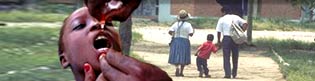
Polio is a highly infectious disease caused by a virus. It invades the nervous system, and can cause total paralysis in a matter of hours - up to 10% of polio patients' die because that paralysis can affect their ability to breathe.
Before the World Health Organisation launched the Global Polio Eradication Programme in the late 1980s there were an estimated 350 000 cases, by the year 2000 that had plummeted to less than 4000 reported cases worldwide.
But people who overcome the disease may still be at risk. A report by the March of Dimes - a voluntary health agency in the US - says that up to eight million polio survivors face the threat of fresh disabilities.
| 'Post-polio syndrome can affect polio survivors up to 40 years after their initial bout of the disease.' |
|
Aging And Post Polio Syndrome
The main symptoms of the condition include muscle degeneration, sever fatigue and pain in the joints.
Dr Christopher Howson is the director of Global Programmes for the March of Dimes. He explains how the syndrome can occur:
'During the initial attack of polio some of the nerve cells in the spinal cord which control muscles - we call them motor neurones - are damaged or destroyed.'
'Fortunately in most individuals some motor neurones survive the initial attack and they send out if you like new nerve connections in an attempt to compensate for the loss of the other motor neurones.'
'Many researchers believe that post-polio syndrome may result in part from some unusual stress placed on these remaining motor neurones. Some research also suggests that post-polio syndrome maybe partly the result of aging.'
By the age of 60 most people begin to lose the motor neurones in their spinal chord. According to Dr Howson, the problem for past polio sufferers is that they already operate with a diminished amount of neurones and quite simply they do not have any spare neurones to lose, therefore accelerating the effects of aging.
Diagnosis
Whilst polio itself has been banished from large swathes of the world, according to the report, post-polio syndrome is not well known to doctors in every country, and is often not diagnosed.
This is exactly the situation that Zohra Rajah in Mauritius experienced when she went to her doctor. In 1945 Rajah suffered from polio infection. She recovered, but now some of the symptoms have returned, affecting muscles in her feet, knees and back. She explains:
'I went to see my doctor. He said, “this must be old age or I don't know what.” Here in Mauritius the doctors don't know about post-polio syndrome. We are teaching them.'
'Some of the doctors aren't familiar with polio at all, because we don't have any cases in Mauritius anymore. We poor victims of polio are suffering now.'
As there is no cure for polio, the best treatment for post-polio syndrome is preventive. A short course of polio vaccine will protect a child for life.
The WHO estimate that the eradication of polio should be complete in 2005, but because post-polio syndrome takes so long to develop problems could still arise long after the disease has been eradicated.
|  |  | | | PPS Awareness |  |
| | Speaking to BBC News Online, Andrew Kemp, of the British Polio Fellowship, said that GPs in particular need to start to recognise post-polio syndrome. He commented:
'In 1998, when we surveyed our members, 98% of respondents thought they had new physical problems caused by their polio, but 66% of general practitioners did not attribute such problems to PPS.' |
|  |
| |