
 HOMEPAGE | BBC NEWS | SPORT HOMEPAGE | BBC NEWS | SPORT | Contact Us | Help | Text Only |
| |
 | |
  | ||||||||
| | | | | | | | |
| ||||||||
| HEALTH | | FAMILY PROBLEMS | | RELATIONSHIPS | | EDUCATION & CAREER | |
| ||||||||
 |
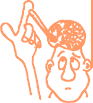 Dear What’s the Problem, My younger sister is thirteen and has always been well rounded. My parents have teased her about this for years, particularly my father, but I don’t think they realise how much it has hurt her. Now she is getting thinner and I am very worried. She never seems to eat properly and I’ve heard her tell our mother that she has eaten at school or at a friend’s house when I know that isn’t true. At mealtimes she takes a long time to eat very little and I think she sometimes deliberately makes herself sick immediately afterwards. I am so scared she may be making herself ill. She seems a different person, never happy anymore, but our parents don’t notice this because they are too busy with their own problems. I’m concerned she may have the illness called anorexia but she won’t talk about it and I don’t know what to do. Santokh Gill, India. Advice: Tricia Kreitman, Counsellor *Santokh’s fears may be quite well founded and perhaps he needs to understand a bit more about anorexia and eating disorders first. At thirteen, the age of his sister, a girl’s body is developing quite fast. It’s very important that girls and boys of this age have a good, healthy, balanced diet because otherwise it can affect later bone growth and the sort of growth that a woman is going to find very important when having children. *But, it’s also the age at which girls, in particular, are the most self-conscious about their looks and Santokh’s sister has been receiving these comments from her parents, perhaps, meant as loving teasing, but she has taken them badly and now she’s trying to lose weight. At thirteen when your body is growing and developing it is absolutely the wrong time to go on a crash diet. *Anorexia and eating disorders often start in this way. You just think, "I’ll skip some meals, I’ll eat a little bit less", but then it becomes an obsession. You become obsessed with food, what you are eating and what you aren’t eating. *You also develop what’s called body dismyopia. When you look at your own body in a mirror you see something that’s much larger than it really is, even when your friends and loved ones say, "You’re getting so thin we’re so worried about you", you still see yourself as being fat and ugly. So, it becomes a real psychological illness that’s very, very hard to break-out of. And sadly a person who’s suffering from it is the last person to see the problem. *Santokh needs to talk to his parents. He’s seeing things, perhaps, because he’s coming and going from the house and so he sees a bigger change. His parents don’t seem to be aware of what’s going on and they have to step into this and start taking some sort of control. *Anorexia is, in itself, a type of control. Young girls in particular enjoy the control they have over their own bodies when they feel that everything else is slipping out of control. It’s interesting that Santokh talks about his parents having their own problems, because, that’s also a common characteristic in young girls with anorexia, they come from troubled homes. They’re often very bright and successful but the parents have their own difficulties that are distracting them from their parenting role. |
The What's the Problem? website is providing general information only. It should not be treated as a substitute for the medical advice of your own doctor or any other health care professional. The BBC is not responsible or liable for any diagnosis made by a user based on the content of the What's the Problem? website. Always consult your own GP if you're in any way concerned about your health. |
| | |
| ||
 | ||
| ||
 | ||
| ||
| FURTHER INFORMATION | ||
| ||
| Eating disorders At this age, on the verge of puberty, girls can be especially self-conscious. Worries about body-image can take hold, and in extreme cases, manifest themselves as eating disorders. It is extremely important at this stage of development that someone eats a well-balanced, nutritious diet, or future health problems can develop. The two main eating disorders are Anorexia and Bulimia. Anorexics will diet to the point of starvation, believing that no matter how thin they become, they are still overweight. Bulimics are more likely to be closer to normal weight, but will binge-eat then make themselves sick. Those suffering from both types of illness will also often abuse dieting pills and other drugs in an attempt to control their weight - this can be extremely risky without medical advice and supervision. The following are possible warning signs for anorexia and bulimia: Unnatural concern about body weight (even if the person is not overweight) Obsession with calories, fat grams and food Use of any medicines to keep from gaining weight (diet pills, laxatives, water pills) More serious warning signs may be harder to notice because people who have an eating disorder try to keep it secret. Watch for these signs: Vomiting after meals Refusing to eat or lying about how much was eaten Fainting Over exercising Not having periods Increased anxiety about weight Callouses or scars on the knucle (from forced vomiting) Denying that there is anything wrong If these warning signs are present, the victim may need immediate help, advice and counselling. As a starting point for understanding more about nutrition and eating disorders, there are many good resources online. | ||
| ||
| ||
| ||
| INTERNET LINKS | ||
| ||
 | ANOREXIA ADVICE FOR YOUNG PEOPLE | |
| HEALTH ADVICE FOR TEENS | |
| ||
| The BBC is not responsible for the content of external Internet sites | ||
